
The Put Call Ratio, also called PCR ratio, is an options trading indicator that compares put open interest with call open interest. Traders use PCR to understand market sentiment, identify bullish or bearish signals, and study possible reversal zones in Nifty, Bank Nifty and stock options.
In short, PCR shows how many traders are betting that the market will go down (puts) or up (calls). Because of this, people see PCR as a measure of mood rather than price. It helps traders figure out what most people in the market are expecting.
What is Put Call Ratio?
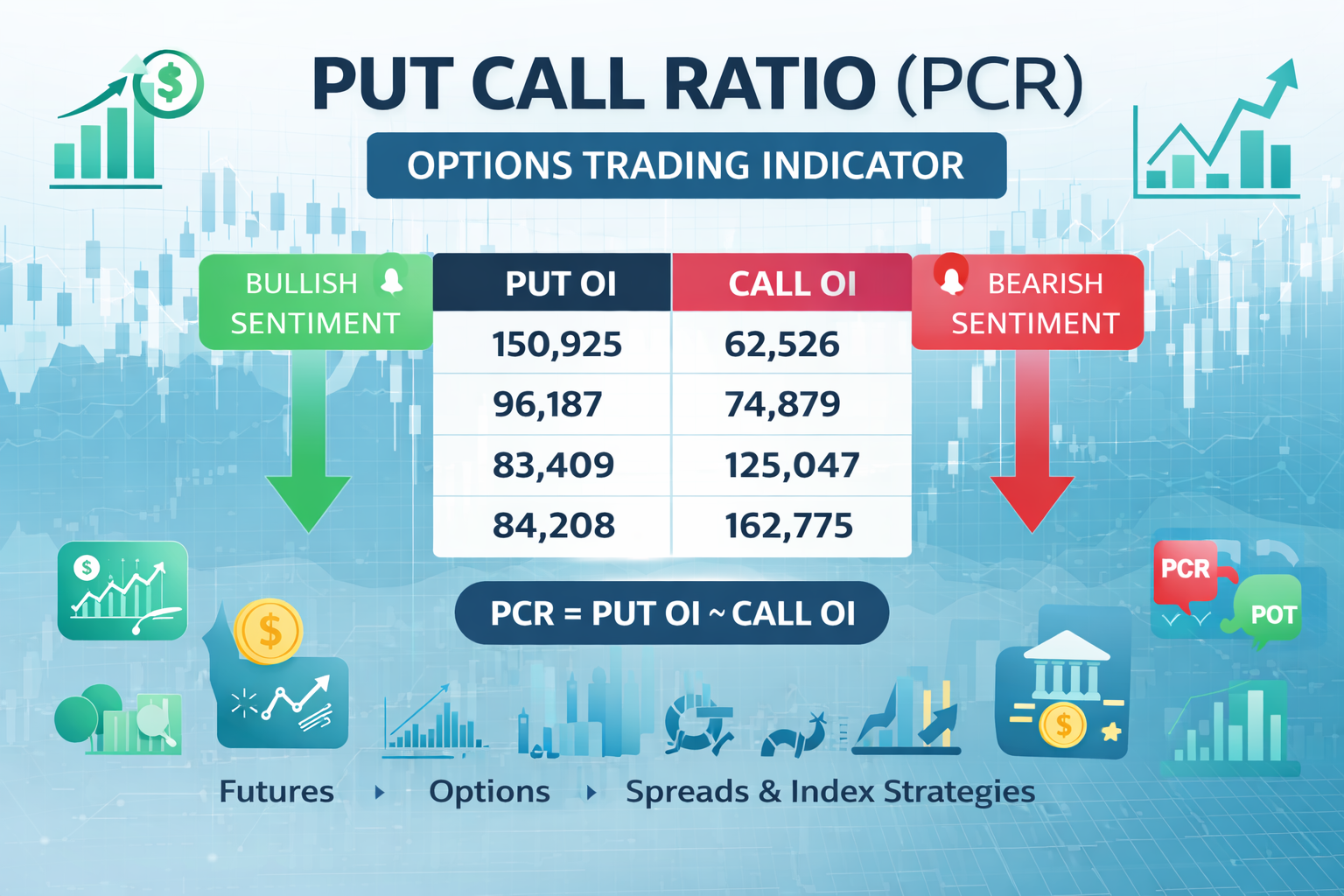
Put Call Ratio is calculated using the following formula:
PCR = Put Open Interest ÷ Call Open Interest
A high PCR value means that there are more put buyers than call buyers. If PCR is low, it means that more people are buying calls than puts.
PCR Ratio Meaning in Stock Market
PCR ratio meaning in the stock market is simple. It shows the relationship between put options and call options. A higher PCR usually means more put activity, while a lower PCR usually means more call activity. Traders use this data to understand whether market sentiment is bullish, bearish or neutral.
Importance of PCR in Trading
PCR is a very helpful tool for figuring out how people feel about the market. When PCR is high, it means that traders are either bearish or protecting themselves against the risk of losing money. When PCR is low, it means that the market is bullish.
Traders can also use PCR to find market reversals. Very high or very low PCR values are often a sign that something has been bought or sold too much. Professional traders use PCR, price action, and other signals to make sure that trends are changing.
PCR Interpretation
| PCR Value | Possible Meaning | Trader Interpretation |
| Below 0.7 | More call activity | Market may be bullish, but overconfidence is possible |
| 0.7 to 1.0 | Balanced sentiment | Market may be neutral or range-bound |
| Above 1.0 | More put activity | Market may be bearish or traders may be hedging |
| Very high PCR | Extreme put activity | Possible reversal zone, but confirmation is needed |
But you should never use PCR by itself. It works best when used with support and resistance levels, option chain analysis, and technical indicators.
What Does PCR 0.87, 0.89 or 1.07 Mean?
A PCR near 0.87 or 0.89 usually shows balanced to slightly cautious market sentiment. It does not give a direct buy or sell signal. Traders should compare it with support-resistance, price action, volume and option chain data.
A PCR above 1.0, such as 1.07, usually means put open interest is higher than call open interest. This may show bearish sentiment or hedging activity. However, very high PCR can sometimes indicate that the market is near an oversold or reversal zone.
A PCR below 0.7, such as 0.64 or 0.69, usually means call activity is higher than put activity. This may indicate bullish sentiment, but traders should confirm it with trend and price action.
How PCR Works in Stock Market
The PCR is based on put/call activity in the options market. Open interest increases with PCR. When open interest increases PCR goes down. Traders use this movement to gauge market sentiment, potential support-resistance levels and shifts in sentiment.
PCR and Support–Resistance
PCR helps find important levels of support and resistance. High put open interest at a certain strike price means there is strong support, and high call open interest means there is strong resistance. Traders can expect breakouts or reversals by keeping an eye on changes in PCR near these levels.
PCR in Index vs Stock Options
Because of high liquidity, PCR is often used in index options like NIFTY and BANK NIFTY. You can also use stock-specific PCR, but you should always check the volume and liquidity to make sure you don't get false signals.
Advantages of Using PCR
-
Easy to calculate and understand
-
Helps identify market sentiment
-
Useful for intraday and positional trading
-
Helps in spotting trend reversals
-
Works well with option chain analysis
Limitations of PCR
-
PCR can give false signals in strong trending markets
-
Should not be used alone
-
Needs confirmation from price action and volume
Conclusion
The Put Call Ratio (PCR) is a strong and easy-to-use tool for options traders. It gives you a good idea of how traders think and where they are in the market. When used correctly with option chain data, technical analysis, and risk management, PCR can make trading decisions and consistency much better. For derivatives traders, knowing what PCR is is important for long-term success.
FAQs
What is the PCR ratio?
PCR ratio means Put Call Ratio. It compares put open interest with call open interest to understand market sentiment in options trading.
What is PCR full form in the stock market?
PCR full form in the stock market is Put Call Ratio.
How to calculate PCR ratio?
PCR ratio is calculated by dividing total put open interest by total call open interest.
What is a good PCR ratio?
A good PCR ratio depends on market conditions. Generally, 0.7 to 1.0 is considered neutral, below 0.7 may show bullish sentiment, and above 1.0 may show bearish or hedging activity.
What does PCR above 1 mean?
PCR above 1 means put open interest is higher than call open interest. It may indicate bearish sentiment, hedging activity or a possible reversal zone depending on price action.
Can PCR be used alone for trading?
No, PCR should not be used alone. Traders should combine it with price action, support-resistance, volume, open interest and risk management.