
Overview
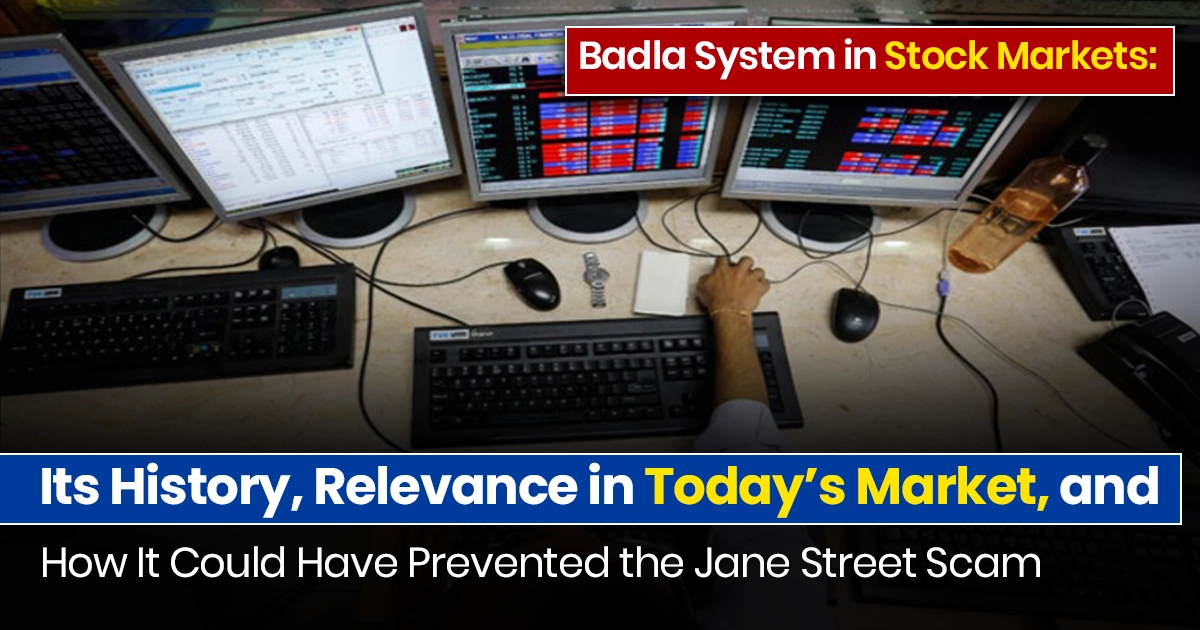
Nowadays, very few traders in the rapidly evolving Indian stock markets are fully aware of the Badla system. In 2001, the Securities and Exchange Board of India (SEBI) formally outlawed Badla trading, which was once thought to be the foundation of Indian trading. By paying a financing fee, it permitted investors to carry forward trades past the settlement period for many years. The mechanism's influence on the Indian market is still significant, even though it disappeared with the introduction of the futures and options (F&O) segment.
In stock markets, the Badla system served as an early example of margin financing in addition to being a tool for creating liquidity. Although the system had advantages and disadvantages, its absence led to new structural imbalances in the trading ecosystem of today, which is frequently overlooked. The Jane Street case demonstrates why the lessons of Badla are still very applicable today, as the company made over ₹36,500 crore in just two and a half years by taking advantage of gaps between the cash and derivatives markets.
The Badla system's history, operation, reasons for SEBI's ban, effect on liquidity, comparison to the F&O markets of today, and potential to stop manipulations like the Jane Street scam are all covered in detail in this article.
The Badla System's Historical Context
One must go back to before the year 2000, when the Indian financial markets were still developing, in order to comprehend Badla trading in India. The National Stock Exchange (NSE) was just starting to gain traction, and the Bombay Stock Exchange (BSE) was the main trading hub. Weekly settlement cycles meant that stock deliveries frequently took seven days to complete.
Under such a system, traders had two choices if they didn't want to settle their trades on the delivery date: either close their positions or carry them over to the following settlement cycle.
The second option was made possible by the Badla system. By paying the counterparty a fee known as the Badla fee, traders could postpone settlement. Because it offered market participants more flexibility, particularly when they had a longer-term perspective but did not want to accept immediate delivery, this mechanism became incredibly popular.
The Badla System's Operation
A straightforward example can help you understand how Badla trading operates. Let's say that during a settlement cycle, a trader purchased 1,000 shares of a company at ₹100 each. The trader may elect to continue the position on the settlement date rather than accepting delivery of these shares. He did this by paying the Badla charge, which was an extra fee of, say, ₹0.50 per share. This fee essentially functioned as the interest expense for retaining the position for an additional settlement period.
In the futures market, where the cost of carry is factored into the futures price, this mechanism was very similar to carry-forward trades. However, Badla trading had the peculiar quality of occasionally going backwards.
When a stock was heavily shorted and the market anticipated that the price would continue to drop, the buyer of that stock might actually get paid to carry on the trade. This was referred to as backwardation, Ulta Badla, or Undha Badla. To put it another way, the trader was paid because his willingness to hold the stock promoted market stability rather than paying for the carry-forward.
Badla and Ulta or Undha Badla's dual nature made it a flexible system that counterbalanced market expectations that were both bullish and bearish.
Why Traders Loved Badla So Much
The Badla system's appeal stemmed from its capacity to offer liquidity, leverage, and opportunities for speculation during a period when India's derivatives market was still in its infancy. Without necessarily bringing in the full amount of capital needed, traders could establish sizable positions in the cash segment. Speculators and arbitrageurs, who required a flexible system to function with less capital, found this to be especially alluring.
By allowing investors to roll over trades without accepting immediate delivery, the system also provided them with an indirect way to hedge positions. It established a single market in which traders, investors, and speculators could all transact with ease.
The Badla system actually became so dominant by the late 1990s that it controlled the majority of trading activity on Indian stock exchanges. Carry-forward trades through Badla were a major source of liquidity for the BSE at the time.
The Issues That Arose with Badla
The Badla mechanism had significant disadvantages in addition to its advantages. Excessive speculation was the main issue. It made it possible for traders to build highly leveraged positions because they could carry forward positions with comparatively small margins.
This drew in manipulators as well as legitimate traders. The 1992 Harshad Mehta scam demonstrated how India's settlement systems' flaws could be used to manipulate prices artificially. Although Badla was not directly responsible for the scam, the system was criticized for encouraging speculative bubbles.
Regulators became aware of Badla's lack of transparency, poor risk management, and potential to destabilize the market during stressful times by the late 1990s.
The Badla System was banned by SEBI.
The Badla system was formally outlawed by SEBI in 2001, and the futures and options segment was implemented in its place. The new F&O market, according to the regulatory body, was more organized, transparent, and well-known throughout the world. Futures contracts were thought to be a safer and more dependable option because of their established margins, settlement procedures, and uniform regulations.
The intention to align Indian markets with international standards also played a role in SEBI's decision. Instead of using native mechanisms like Badla, the majority of developed markets used futures and options.
As a result, the Badla era came to an end in 2001, and India started its transition to a contemporary trading environment driven by derivatives.
Badla Ban's Effect on Market Liquidity
There were both short-term and long-term effects from the prohibition on Badla trading. On the one hand, it decreased the likelihood of excessive leverage, enhanced transparency, and reinforced risk management procedures. However, it led to a significant imbalance between the derivatives and cash markets.
The trading volume of the Indian futures and options market is currently 200–400 times higher than that of the cash market. This leads to a paradox: although futures prices are calculated mathematically from cash prices, the cash market has so little liquidity that it is relatively easy to manipulate.
There is more to this structural flaw than meets the eye. As demonstrated in the Jane Street case, where a multinational trading company exploited precisely this weakness, it has actual repercussions.
The Case of Jane Street: Taking Advantage of the Cash-Futures Mismatch
The well-known international trading company Jane Street found that there was a special opportunity in the Indian markets. Futures contracts can be indirectly manipulated because they are based on cash market prices, but the cash market had very little liquidity.
Jane Street was able to affect stock prices by making comparatively small trades in the cash segment. Jane Street had already established sizable positions in the much larger futures market, which was automatically impacted by these minor changes in cash prices.
The company was able to make almost ₹36,500 crore in profits from Indian stock markets in just 2.5 years by repeating this strategy methodically. The case demonstrated how large players may be able to engage in sophisticated manipulation due to the fragmented liquidity between the cash and derivatives markets.
Would This Have Been Avoided by the Badla System?
Such tactics probably would have been much more challenging to execute if the Badla system had remained in place. A single pool of liquidity was created under Badla by combining the cash and carry-forward trades. It was much more difficult to manipulate prices with small orders because they were set in a market where speculative and delivery trades coexisted.
Essentially, the current system has fragmented liquidity between cash and derivatives, whereas Badla concentrated liquidity. Jane Street was able to make money precisely because of this fragmentation. The lesson here is that, in spite of their shortcomings, older systems can occasionally offer structural protections that more recent systems fail to consider.
Contemporary Reverberations of Badla in Current Markets
The logic of the Badla system is still evident in some areas of modern markets, despite its discontinuation. Futures contracts, for example, occasionally trade below cash prices. This reminds me a lot of the old Undha or Ulta Badla phenomenon.
The futures price may drop below the spot price, indicating bearish sentiment, when the market anticipates a stock decline. Traders who comprehend this dynamic are able to spot hedging or arbitrage opportunities.
As a result, even though Badla is no longer in existence, its fundamental ideas are still present in contemporary trading practices.
Lessons for Traders and Regulators
Every trading mechanism has trade-offs, as the Badla system's story teaches us. Although SEBI was right to place a high priority on risk management and transparency, Badla's dismissal introduced additional vulnerabilities in the form of fragmented liquidity.
Recognizing the significance of balanced liquidity across the cash and derivatives markets is the main takeaway for regulators. The lesson for traders is that market structure is just as important as stock fundamentals. Traders can foresee flaws in existing systems and steer clear of manipulation by researching the past.
Commonly Asked Questions (FAQs)
Q1. What was the stock market Badla system?
By paying or receiving a financing charge, traders could extend their positions past the settlement period through the Badla system, a carry-forward mechanism. Before being outlawed in 2001, it was well-liked in India.
Q2. Why did SEBI ban the Badla system?
Because of worries about excessive speculation, a lack of transparency, inadequate risk management, and manipulation susceptibility, SEBI banned the Badla system. Futures and options (F&O) trading took its place.
Q3. What was the difference between trading futures and badla?
In contrast to futures contracts, which are distinct standardized instruments, Badla was incorporated into the cash market, even though both involved the cost of carrying positions forward. Futures fragmented liquidity, but Badla created a single market.
Q4. What was Reverse Badla or Undha?
When traders were paid for carrying forward positions rather than making payments, this was known as Undha or Ulta Badla. This occurred when there was a high demand to carry forward short positions in stocks that were heavily short-sold.
Q5. Was the Jane Street scam avoidable with the Badla system?
Yes, to a significant degree at least. It would have been much more difficult for a big trader to indirectly influence futures prices through tiny trades in the cash segment because Badla concentrated liquidity in the cash market.
Q6. Is there anything comparable to Badla nowadays?
When futures contracts trade at discounts to cash prices, resembling Reverse Badla scenarios, the essence of Badla is evident even though Badla itself is no longer present. Trading insights can still be gained from these patterns.