
Budget 2026 LIVE Updates: What FM Sitharaman Announced and What It Means for India, Markets, and Investors

Budget 2026 LIVE Updates: What FM Sitharaman Announced and What It Means for India, Markets, and Investors

Why Budget 2026 Is a High-Impact Economic Event 

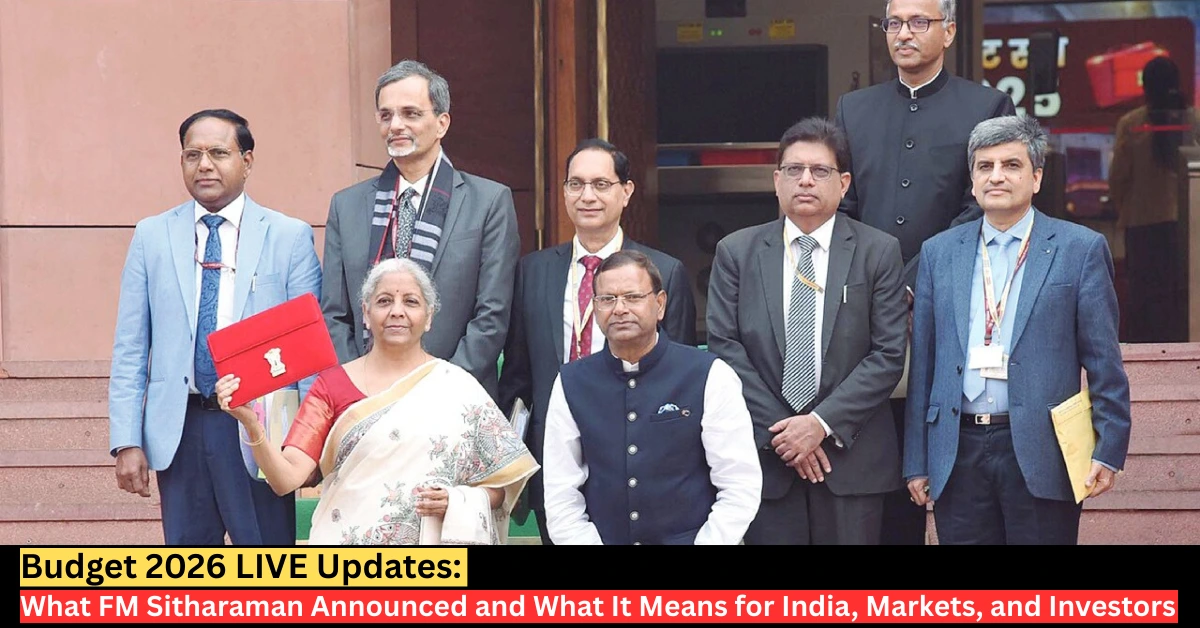
The Union Budget for FY2026–27, presented by Nirmala Sitharaman on Sunday, 1 February 2026, is one of the most consequential policy announcements for India’s economy this year. Delivered at 11 a.m. in Parliament, this was the Finance Minister’s ninth consecutive Budget, setting the direction for fiscal policy, capital spending, taxation, trade, and financial markets.

At a time when global growth remains uneven and supply chains are still adjusting, Budget 2026 outlines how India plans to sustain momentum while continuing its path of fiscal consolidation. The government has pegged the fiscal deficit for FY27 at 4.3% of GDP, signalling restraint even as it expands public investment.

What Were the Core Announcements in Budget 2026? 

A central headline from Budget 2026 was the rationalisation of customs duties across several categories. The Finance Minister proposed exempting import duty on select items, including aviation components and aircraft maintenance parts, a move aimed at reducing airline operating costs and positioning India as a global aircraft MRO hub.

Healthcare also emerged as a major focus. The Budget announced basic customs duty exemption on 17 cancer drugs, while expanding the list of rare diseases eligible for duty-free personal imports of medicines and special medical food. These steps directly address affordability concerns in high-cost treatments.

Alongside these measures, the government reaffirmed its growth strategy by sharply increasing capital expenditure to ₹12.2 trillion for FY27, reinforcing infrastructure, manufacturing, and employment creation as policy priorities.

How Capital Expenditure and Industrial Policy Shape FY27

Public investment remains the backbone of Budget 2026. The increase in capex from ₹11.2 trillion in FY26 to ₹12.2 trillion in FY27 is designed to crowd in private investment and strengthen long-term productivity.

The Budget also introduced a forward-looking industrial agenda. This includes the creation of rare earth corridors in mineral-rich states such as Tamil Nadu, Kerala, Odisha, and Andhra Pradesh to reduce dependence on critical mineral imports. Complementing this is a ₹20,000 crore carbon capture and utilisation outlay for emission-intensive sectors like steel and cement.

Manufacturing received additional support through expanded electronics production, Semiconductor Mission 2.0, container manufacturing, mega textile parks, and a new SME growth fund aimed at reviving industry clusters.

Which Sectors Are Directly Impacted by Budget 2026?

Budget 2026 spreads its impact across multiple high-employment and high-investment sectors. Logistics and infrastructure are addressed through new freight corridors, operationalisation of national waterways, and a Coastal Cargo Promotion Scheme that aims to raise the share of inland waterways and coastal shipping from 6% to 12% by 2047.

The services of biopharma hubs, medical tourism, and lower import expenses for essential medications support healthcare and biopharma. In addition to tourism and cultural development, plans are in place to develop archaeological sites, eco-tourism pathways, and train thousands of tourist guides.

Budget 2026: Key Numbers at a Glance

IndicatorBudget 2026 Announcement
Fiscal Deficit (FY27)4.3% of GDP
Capital Expenditure₹12.2 trillion
Carbon Capture Outlay₹20,000 crore
Duty-free Cancer Drugs17 medicines
STT on FuturesRaised to 0.05%
Foreign / PIO Investment LimitRaised to 24%
Municipal Bond Incentive₹100 crore (₹1,000+ crore issue)

How Budget 2026 Changes Taxation and Compliance

On the tax front, Budget 2026 focused on easing compliance while maintaining stability. The Finance Minister proposed extending the ITR revision deadline to 31 March with a nominal fee and introducing a rule-based automated process for small taxpayers.

TCS rates on overseas tour packages, education, and medical remittances under LRS were reduced to 2%, easing cash-flow pressure on individuals. Importantly for investors, long-term and short-term capital gains taxes were left unchanged, providing continuity.

The Budget also removed TDS on interest awarded by motor accident claims tribunals and offered immunity from prosecution for minor foreign asset disclosure lapses below ₹20 lakh.

What Budget 2026 Means for Stock Market Participants 

For market participants, Budget 2026 delivered several meaningful signals. The government announced an increase in Securities Transaction Tax (STT) on futures and options, indicating tighter oversight of derivatives trading.

At the same time, steps were taken to deepen capital markets. The Budget proposed allowing individuals resident outside India to directly buy Indian equities, while raising the combined investment cap for such investors and Persons of Indian Origin to 24%.

Bond markets also received attention through incentives for large municipal bond issuances, the introduction of total return swaps on corporate bonds, and a review of foreign exchange management rules governing non-debt instruments.

Why Budget Headlines Need Deeper Interpretation 

Market reactions to budget announcements are immediate, but real impacts are long-term. For instance, timelines related to capex, taxes, access to foreign investment, sectoral incentives, and any budget measures are likely to impact earnings visibility, liquidity, and risk over time.

Understanding these linkages is what separates reactive trading from informed decision-making.

How to Build Market Skill from Events Like Budget 2026 

Union Budget 2026 once again highlights the importance of structured market understanding. Traders and investors who can interpret policy changes, taxation tweaks, and macro signals are better positioned to navigate volatility and identify opportunity across market cycles.

Institutions such as ICFM INDIA focus on helping learners understand how real-world developments like Union Budgets, earnings, and policy decisions translate into practical market insight — moving beyond headlines to informed strategy.

Final Takeaway

Budget 2026 reflects a policy framework centred on investment-led growth, industrial resilience, healthcare access, and capital-market deepening, while maintaining fiscal discipline. For investors and traders, the real edge lies not in reacting to Budget headlines, but in understanding how these measures shape markets over time.

As markets digest these announcements, informed interpretation — not impulse — will remain the key differentiator.

Budget 2026 & Stock Market Impact (FAQs)

Why is Budget 2026 important for the Indian stock market?

Budget 2026 is important for the stock market because it sets the direction for government spending, taxation, and investment priorities for the year ahead. Measures such as higher capital expenditure, changes in Securities Transaction Tax, foreign investment limits, and sector-specific incentives directly influence market sentiment, sector rotation, and medium-term earnings expectations.

How will the ₹12.2 trillion capex announced in Budget 2026 impact markets?

The increase in capital expenditure to ₹12.2 trillion is expected to support infrastructure, manufacturing, and employment-led growth. Historically, sustained capex spending improves order flows for infrastructure, capital goods, cement, steel, and logistics companies, which can positively influence equity markets over the medium term.

What does the 4.3% fiscal deficit target mean for investors?

A fiscal deficit target of 4.3% of GDP indicates that the government is balancing growth with fiscal discipline. For investors, this reduces concerns around excessive borrowing, inflationary pressure, and interest rate volatility, creating a more stable macro environment for equities and bonds.

How does the increase in STT on futures and options affect traders?

Active derivatives traders are impacted by the increased transaction costs due to the rise in the Securities transaction tax on the F&O. While this may dampen short-term speculative activities, it may also entice some traders to mentally shift to more disciplined strategies, risk management, and higher probable trade setups.

Did Budget 2026 change long-term or short-term capital gains tax?

No. Budget 2026 did not make any changes to long-term capital gains (LTCG) or short-term capital gains (STCG) tax rates. This provides continuity and clarity for long-term investors and reduces uncertainty around equity taxation.

Can foreign investors buy Indian stocks directly after Budget 2026?

Yes. Budget 2026 proposed allowing individuals resident outside India to invest directly in Indian equities through a simplified portfolio investment route. The combined investment limit for such investors and Persons of Indian Origin has also been raised to 24%, which may improve liquidity and broaden market participation.

Which sectors could benefit most from Budget 2026?

Sectors likely to see medium-term benefits include infrastructure, capital goods, logistics, metals, healthcare, biopharma, electronics manufacturing, and renewable-linked industries. The focus on rare earth corridors, carbon capture, and semiconductor manufacturing also highlights emerging strategic sectors.

How do customs duty exemptions announced in Budget 2026 impact the economy?

Exemptions from customs duties on some medicines and parts used in the aviation industry are beneficial as they lower operational costs and take pressure off the health care system. Over time, these measures enhance competitiveness, foster growth in certain sectors, and alleviates cost pressures for consumers and businesses.

Why do markets often turn volatile after the Union Budget?

Markets tend to be volatile after the Budget because traders and investors reassess expectations based on policy changes, tax proposals, and spending priorities. Short-term volatility is common, but medium-term trends depend on execution, earnings growth, and global cues.

How should investors interpret Budget news instead of reacting emotionally?

Rather than focusing on mere headlines, investors must try to understand a Budget's earnings visibility, demand, liquidity, tax implications, and other related impacts. This allows them to formulate a more precise answer, analysing the policy’s intent, capex distribution, and structural adjustments.

How can beginners and traders learn to read Budget impact on markets?

Reading the Budget impact requires structured understanding of macroeconomics, sector dynamics, taxation, and market behaviour. Learning how policies translate into price action and long-term trends helps traders and investors avoid emotional decisions.

Read by 0 Visitors
Lakshay Jain
About author
Lakshay Jain
From
Delhi

( Submitted News & Articles = 51 )

Search Engine Optimisation Specialist (SEO)


Download ICFM APP

Stock Market courses App