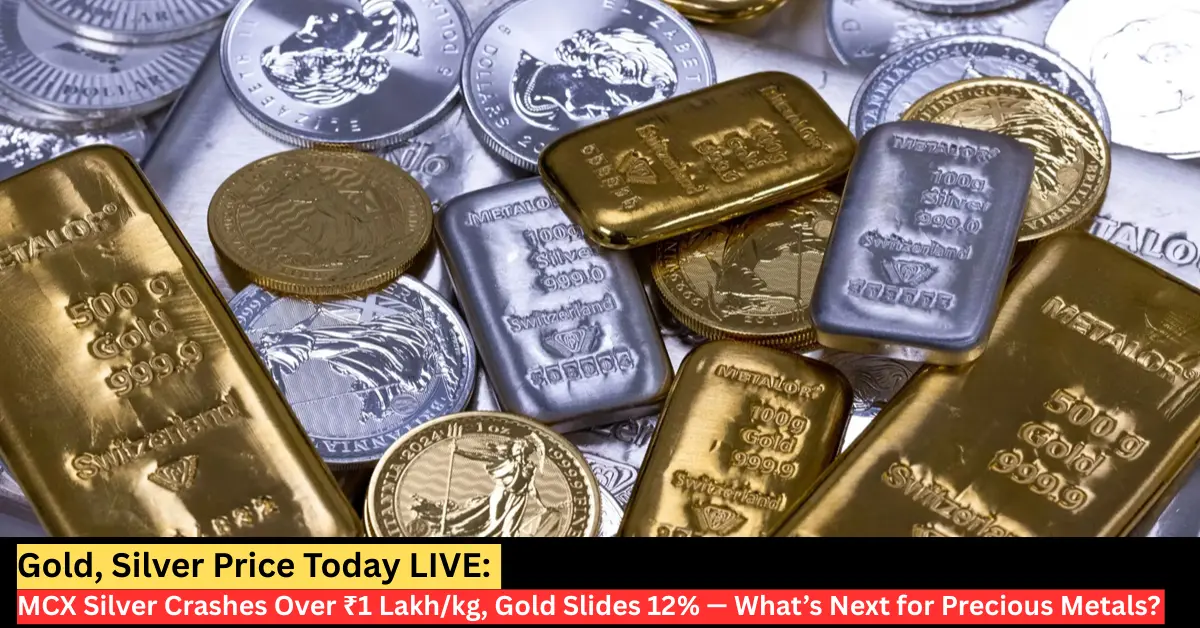
Gold and silver prices witnessed an abrupt and severe sell-off during Friday’s trading session, rattling commodity markets in India and across the globe. After reaching all-time highs this month, both precious metals experienced sharp reversals. This was due to a combination of rapid profit booking, heavy speculative positioning, and regulatory actions.
Investors are now wondering if the recent rally in gold prices and silver prices will be able to sustain itself or if it has already peaked due to the sharp drop in prices and the market now focusing on downside risk rather than the previously predicted upside momentum.
Who Triggered the Crash in Gold and Silver Prices?
The immediate trigger for the sell-off was a margin hike announced by CME Group, which raised the margin requirement for gold futures from 6% to 8% and for silver futures from 11% to 15%, effective Monday, 2 February 2026.
Margin increases raise the amount of capital traders need to keep for their futures positions. Given the fact that the markets are heated and already over-leveraged, such changes will often lead to fast unwinding of positions. This caused rapid liquidation in all exchanges, transforming a simple correction into a disordered and severe drop.
What Happened to MCX Gold and MCX Silver on Friday?
The domestic commodity market bore the full impact of the global sell-off. MCX gold futures dropped nearly 12%, settling at ₹1,49,075 per 10 grams, a fall of over ₹20,000 from the previous close. The decline erased a significant portion of gains built during the recent rally.
MCX silver suffered even heavier damage. Silver prices plunged around 27% in a single session, wiping out more than ₹1,00,000 per kilogram in value. The contract closed near ₹2,91,922/kg, marking one of the steepest one-day declines in the history of Indian silver trading.
MCX and Global Market Snapshot (31 January 2026)
| Segment | Asset | Previous Close | Latest Close | Absolute Change | % Change |
| India (MCX) | Gold Futures (₹/10g) | ₹1,69,403 | ₹1,49,075 | -₹20,328 | -12.0% |
| India (MCX) | Silver Futures (₹/kg) | ₹3,99,893 | ₹2,91,922 | -₹1,07,971 | -27.0% |
| Global (COMEX) | Gold (USD/oz) | $5,354.8 | $4,907.5 | -$447.3 | -8.35% |
| CME Margin Change | Gold Futures | 6% | 8% | Margin Raised | Feb 2, 2026 |
| CME Margin Change | Silver Futures | 11% | 15% | Margin Raised | Feb 2, 2026 |
Source: MCX official data, CME Group, COMEX
Why Did the Correction Turn So Violent?
The rapid decline extent mirrors the tightness of the precious metals trade. With the global economic uncertainty, large speculative interest had driven the prices of gold and silver. As margins increased, leveraged positions started to unwind and triggered stop-losses and lower circuits.
Concurrently, a tightening US dollar and changing expectations regarding US monetary policy put additional strain on the US precious metals markets. Silver, which is more structurally volatile than gold, absorbed the most damage during this forced liquidation wave.
Will Gold Recover When Markets Reopen?
The next trading session is critical. According to Amit Goel, Chief Global Strategist at Pace 360, the $4,900 per ounce level on COMEX gold will act as a key reference point.
He warned that if gold does not reclaim this level, it might show that the rally is topped out. In that case, prices could drift lower in the coming months with downside targets of $3,800 per ounce as of October 2026. Additionally, any decline expected is not likely to be smooth. There will be a number of pullback rallies before the decline.
What Should Investors Learn From Friday’s Silver Crash?
Commenting on the extreme volatility, Nithin Kamath, CEO of Zerodha, highlighted a crucial lesson for market participants.
He noted that multiple metals hit lower circuits in a single session, with silver crashing nearly 30% and gold falling around 15%. His message was clear: trading without disciplined risk management can wipe out years of gains in just one day, especially when market gaps and exit opportunities vanish.
How Traders Convert COMEX Gold and Silver Prices to MCX Levels
During increased global market volatility, Indian traders monitor sentiment on COMEX prices, but transact on MCX. Since MCX contracts have different specifications than COMEX contracts, and are dollar-denominated whereas MCX contracts are in Indian Rupees, prices cannot be directly compared.
To interpret global price action accurately in the Indian context, ICFM India maintains a COMEX to MCX Calculator. The tool factors in international prices, the USD–INR exchange rate, contract conversion ratios, and time remaining until expiry, allowing traders to align global cues with domestic trading levels more precisely.
What Lies Ahead for Precious Metals?
In the short term, as markets adjust to the new margins and positions normalise, volatility will most likely remain elevated. After the liquidation dust settles, investors' confidence will hinge on whether gold and silver can hold position above critical support zones.
Although gold and silver retain some long-term relevance as hedge assets, recent crashes warn us that sharp rallies can quickly unwind, especially with increased leveraging. Moving forward, it is likely that 'discipline,' 'protection of capital,' and 'structured decision-making' will be more important than aggressive positioning.
Final Takeaway: Structure Beats Emotion in Volatile Markets
Market shocks test much more than just the direction of the price, they test the level of preparation of the market participants. During such phases, the over-leveraged emotional traders get exposed, while the disciplined, framework-driven, and risk-controlled traders are able to thrive.
At ICFM India, the focus is on helping market participants understand market structure, volatility behaviour, and risk management, particularly during high-impact events such as commodity crashes. The objective is not prediction, but preparedness — enabling traders to act with clarity rather than panic when markets move fast.
Frequently Asked Questions: Gold & Silver Price Crash
Why did gold and silver prices crash so sharply today?
A variety of causes including the CME group announcing higher margin requirements, the US dollar strengthening, and aggressive profit taking by leveraged traders, resulted in a sharp decline in the prices of gold and silver. An increase in margin requirements means that traders must lower their positions, which in turn, increases the selling pressure in markets that are already overbought.
How much did MCX gold and MCX silver fall in one day?
On Friday, MCX gold dropped just under 12% and fell below ₹20,000 per 10 grams, while MCX silver crashed around 27% and lost more than ₹1 lakh per kilogram. Such movements are among the largest one-day declines in the history of Indian commodity markets.
Is the gold and silver crash limited to India?
No. The sell-off was global. COMEX gold prices dropped more than 8%, reflecting a broader international correction triggered by margin tightening, dollar strength, and the unwinding of speculative positions across global exchanges.
Will gold prices recover when markets reopen?
The near-term outlook depends on whether COMEX gold regains the $4,900 per ounce level. According to market experts, failure to reclaim this level could indicate that the recent rally has topped out, while a recovery above it may help stabilize sentiment.
Can gold prices fall further from here?
Some analysts opine that gold prices will continue to be under pressure over the medium term, unless gold starts reclaiming the key resistance levels. Declines will however be more choppy, as there will be pullback rallies, even if there are intermittent declines.
Why is silver falling more than gold?
The liquidity in silver markets is thinner and there are more speculative activities which is why silver prices are more volatile compared to gold. Due to more aggressive unwinding of leveraged positions, we can expect silver to fall faster and deeper in situations when there are margin-triggered sell-offs.
What lesson should investors learn from this crash?
The main point is the need to manage risk. Sudden market gaps, margin increases, and circuit breakers can remove chances to exit. Overleveraging and having no risk parameters can lead to significant loss of capital during highly volatile market periods.
Is this a good time to buy gold or silver?
This depends on an individual’s time horizon and risk tolerance. Judging by long-term investors, sharp corrections may be perceived to represent potential accumulation phases. Even so, the short-term volatility remains pronounced. Experts tend to recommend staggered entries rather than whole-period exposure during such times.
How do global COMEX prices affect MCX gold and silver?
Global COMEX prices act as a reference for sentiment and direction, but Indian MCX prices are influenced by additional factors such as USD–INR movement, contract specifications, and local demand-supply dynamics. Proper conversion is essential to interpret global cues accurately.
Why do margin hikes cause sudden market crashes?
Margin increases raise the amount of capital needed to maintain futures positions. Margin calls on positions that do not meet the higher requirements liquidate these positions, resulting in instant exits. This causes quick liquidations and sharp declines in prices, more so in leveraged markets.
Are gold and silver still safe-haven assets after this fall?
Despite short-term volatility, gold and silver continue to be viewed as long-term hedge assets against inflation, currency risk, and geopolitical uncertainty. However, short-term price movements can remain highly volatile when leverage dominates market behaviour.
Why is volatility expected to remain high in precious metals?
After sharp corrections, markets typically go through a phase of price discovery as positions normalise. Higher margins, cautious participation, and uncertain global cues can keep volatility elevated until a new equilibrium is established.
How can traders prepare better for such volatile market phases?
Recognized professionals concentrate on safeguarding their capital, maintaining consistent position sizing, and grasping the impact of international developments on domestic pricing. Systematic education and well-defined risk parameters alleviate the impact of emotional reasoning during rapidly shifting market conditions.