
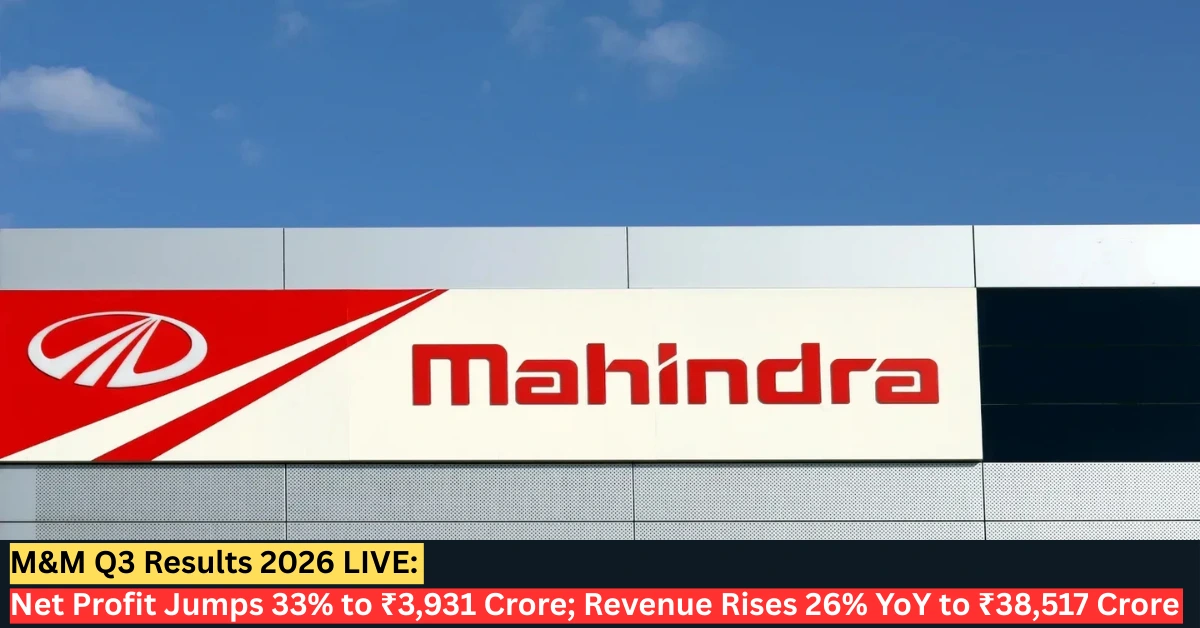
M&M Q3 Results 2026 LIVE: Net Profit Jumps 33% to ₹3,931 Crore; Revenue Rises 26% YoY to ₹38,517 Crore

M&M Q3 Results 2026 LIVE: Net Profit Jumps 33% to ₹3,931 Crore; Revenue Rises 26% YoY to ₹38,517 Crore

What Did Mahindra & Mahindra Report in Q3 FY26?

When a big car company makes more than 30% more money, the markets pay attention. But what's more important is why that growth happened and if it will last.

Auto major Mahindra & Mahindra (M&M) announced strong Q3 FY26 earnings on 11 February 2026, reporting a 32.6% year-on-year increase in standalone net profit to ₹3,931.30 crore, compared to ₹2,964.31 crore in the same quarter last year.

Revenue from operations grew 26.12% YoY to ₹38,516.8 crore, up from ₹30,538.2 crore. The growth was driven by strong performance across both automotive and farm equipment segments, reflecting diversified demand strength.

At the operational level, EBITDA rose 27% YoY to ₹5,668 crore, while EBITDA margin improved slightly to 14.7% from 14.6%, signalling operational stability despite cost pressures in the sector.

The key takeaway is not just revenue growth — it is the expansion in earnings efficiency.

Why Did Net Profit Rise 33% Year-on-Year?

Volume growth and operating leverage were the main reasons for the strong growth in earnings. The total number of sales in the December quarter rose 23.1% from the same time last year to 4,22,937 units. This shows that demand is stable and prices are healthy.

Automotive segment revenue rose 26.55% YoY to ₹28,361.48 crore, while segment EBIT increased 23.85% YoY to ₹2,683.94 crore. SUV revenue market share improved to 24.1%, up 90 basis points, reflecting competitive strength in the premium utility vehicle category.

The farm equipment part also did well. Revenue went up 24.88% to ₹10,199.69 crore, and EBIT went up 39.36% YoY to ₹2,060.78 crore because of better margins and high demand for tractors.

How Did the Auto and Tractor Segments Perform?

The automotive business recorded 23% YoY growth in total auto sales to 3,02,238 units, compared to 2,45,499 units last year. Premium SUVs and strong market positioning supported the revenue expansion.

The tractor business posted 23% YoY growth in total tractor sales to 1,49,567 units, up from 1,21,774 units. Although tractor market share in Q3 stood at 44.0%, the company maintained leadership in the segment.

Below is a consolidated financial comparison:

M&M Q3 FY26 vs Q3 FY25 Performance

MetricQ3 FY26Q3 FY25YoY Growth
Net Profit₹3,931 Cr₹2,964 Cr32.6%
Revenue₹38,517 Cr₹30,538 Cr26.1%
EBITDA₹5,668 Cr₹4,468 Cr27%
EBITDA Margin14.7%14.6%+10 bps
Auto Sales3,02,238 units2,45,499 units23%
Tractor Sales1,49,567 units1,21,774 units23%

These numbers align closely with brokerage expectations of nearly 30% revenue growth and around 33% profit expansion.

Who Commented on the Performance and What Was Said?

Amarjyoti Barua, the group's CFO, said that the consolidated results show how strong M&M's diverse portfolio is, with services businesses making more money and a strong balance sheet position.

Rajesh Jejurikar, Executive Director and CEO (Auto and Farm Sector), noted a 90 basis point increase in SUV revenue share and a 10 basis point rise in LCV market share. Management commentary suggests confidence in both urban SUV demand and rural tractor momentum.

Where Does M&M Share Price Stand After the Results?

M&M shares were trading over 2% higher around the time of results. Over the longer term, the stock has delivered 175% returns in three years, 310% in five years, and 566% in ten years, establishing itself as a multibagger in the auto space.

Short-term price action will now depend on institutional positioning, margin sustainability, and broader Nifty Auto sentiment.

What Should Investors Watch Going Forward?

Investors will keep a close eye on the direction of margins, especially whether EBITDA margins can stay above 15%. In the next few quarters, rising input costs, discount trends in the auto segment, and stable demand in rural areas will be important factors.

Brokerage commentary indicates potential margin expansion in the tractor segment, while the auto segment may witness only marginal improvement due to pricing pressures.

How Does This Earnings Report Fit Current Market Trends?

The results from Q3 support the story of growth driven by volume and operating leverage. M&M is in a good position in the auto industry because of high demand for SUVs, steady sales of tractors, and stable margins.

High-intent queries right now include analyzing earnings growth, margin sustainability, the effect on share prices, and the potential for multibaggers. This structured breakdown answers those questions directly with clear facts and data that can be compared.

Why Understanding Earnings Analysis Matters

Quarterly numbers often create immediate excitement, but interpreting revenue composition, segment margins, and operating leverage requires financial literacy.

ICFM India focuses on helping learners understand how to analyse profit growth, EBITDA trends, market share expansion, and balance sheet strength in a structured manner. Instead of reacting emotionally to earnings headlines, investors benefit from disciplined financial analysis.

In markets, information is abundant. Interpretation is what creates an advantage.


Frequently Asked Questions: M&M Q3 Results 2026 & Share Price Outlook

1. Why did M&M’s net profit jump 33% in Q3 FY26?

M&M’s standalone net profit rose 32.6% year-on-year to ₹3,931 crore primarily due to strong volume growth in SUVs and tractors, operating leverage benefits, and stable EBITDA margins. Revenue increased 26%, but profit grew faster because fixed costs were absorbed more efficiently as sales volumes expanded.

2. How much revenue did M&M generate in Q3 FY26?

M&M reported revenue from operations of ₹38,517 crore in Q3 FY26, marking a 26.12% year-on-year increase from ₹30,538 crore in the same quarter last year. Growth was supported by both automotive and farm equipment segments.

3. How did M&M’s SUV business perform in Q3?

M&M’s SUV revenue market share increased to 24.1%, up 90 basis points year-on-year. Automotive segment revenue grew 26.55% to ₹28,361 crore, reflecting sustained demand for premium utility vehicles and new launches.

4. How strong was the tractor segment in Q3 FY26?

The farm equipment segment delivered revenue of ₹10,199 crore, up nearly 25% year-on-year. Tractor sales rose 23% to 1,49,567 units. Segment EBIT increased over 39%, indicating margin expansion alongside volume growth.

5. What was M&M’s EBITDA margin in Q3 FY26?

M&M reported an EBITDA margin of 14.7% in Q3 FY26, slightly higher than 14.6% in the previous year. The improvement reflects operating efficiency despite rising input costs and competitive pricing pressures.

6. How did M&M share price react after Q3 results?

M&M shares traded over 2% higher following the earnings announcement. The stock has delivered 175% returns in three years, 310% in five years, and 566% in ten years, reflecting long-term earnings growth and market share gains.

7. Is M&M still a multibagger stock after Q3 results?

M&M has already delivered multibagger returns over the long term. Future performance will depend on margin sustainability, SUV demand strength, rural tractor growth, and competitive intensity in the auto sector. Continued earnings compounding will determine whether the stock maintains its growth trajectory.

8. What should investors watch after M&M’s Q3 earnings?

Investors should monitor EBITDA margin sustainability above 15%, input cost trends, rural demand stability, and SUV segment competition. Operating leverage and consistent volume growth will be key drivers of future earnings momentum.

9. Did M&M beat market expectations in Q3 FY26?

Brokerages had estimated around 30% revenue growth and 33% profit growth for Q3 FY26. M&M’s reported numbers broadly aligned with expectations, reinforcing confidence in operational execution.

10. What does M&M’s Q3 performance indicate about the auto sector?

M&M’s strong Q3 results suggest resilient SUV demand and stable rural consumption. The balanced performance across urban and rural segments reflects structural demand trends rather than short-term cyclical recovery.

Read by 0 Visitors
Lakshay Jain
About author
Lakshay Jain
From
Delhi

( Submitted News & Articles = 51 )

Search Engine Optimisation Specialist (SEO)


Download ICFM APP

Stock Market courses App