
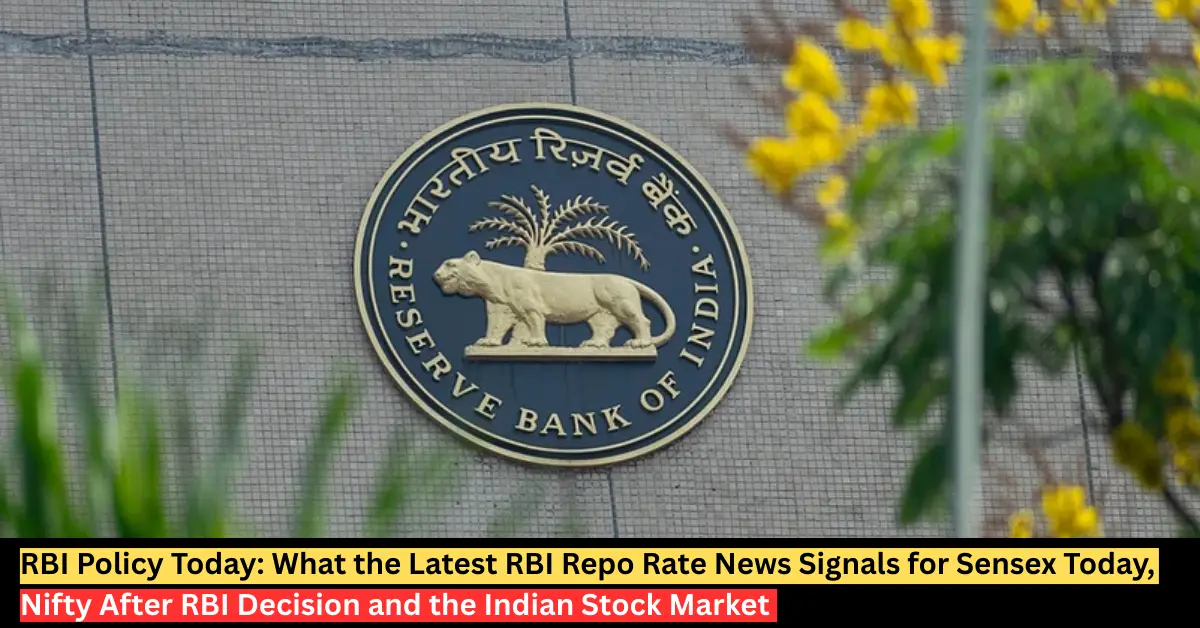
When RBI policy today trends at the same time as Sensex today, BSE share price, MCX share price, and Groww share price, it is rarely a coincidence. It usually signals that the market is repricing risk in real time. The latest RBI monetary policy update has triggered fresh debate around liquidity, interest rates, and inflation outlook—factors that directly influence how the Indian stock market moves in the coming sessions.
Today's RBI announcement alters more than just a number. It changes market expectations. It will influence bond yields; banking margins; sector momentum; overall investor sentiment. That is why policy hour searches for stock market news increase instantaneously. Traders and investors want an answer on what this will mean for portfolio direction in the immediate future.
What Did the Latest RBI Monetary Policy Update Say?
The recent RBI monetary policy update delivered guidance on growth, inflation trajectory, and overall policy stance. Markets often respond not just to the repo rate level, but to the language around inflation control and liquidity management.
Whenever RBI repo rate news hits the market, traders immediately connect it to the cost of capital. If borrowing becomes more expensive, earnings assumptions can soften. If liquidity remains supportive, valuations often get breathing room. That is why the RBI impact on stock market can appear fast and sharp even before the broader economy “feels” the policy change.
What matters most is whether the policy signals a continuation of the current rate cycle or the beginning of a turning point.
Why Does RBI Policy Today Move Indices Like Sensex Today So Quickly?
The RBI impact on stock market is structural because monetary policy changes liquidity and the expected path of interest rates. Liquidity affects how easily capital flows into equities, and interest rate expectations influence how investors value future earnings.
The Sensex reaction to RBI usually begins with banks because banking profitability is linked to rate transmission. A policy stance that supports margins or credit growth can lift financial stocks, while a stance that tightens liquidity can trigger cautious positioning.
The Nifty index response at a sectoral level post-RBI decision showcases how different sectors reprice simultaneously. Sectors like banking, real estate, and consumer durables, which are sensitive to rates, tend to be the quicker responders. Spans with heavier growth may respond to shifts in bond yields and international risk indicators.
How Does RBI Inflation Outlook Shape the Direction of the Indian Stock Market?
The RBI inflation outlook often carries more market weight than the headline rate decision. Inflation projections shape expectations about how long policy will stay tight or when easing becomes possible.
When inflation is discussed, bond yields tend to rise, and equity valuations are determined by those yields. Increased bond yields mean that expensive growth stocks will be impacted negatively. However, if yields become stable, investors may become more willing to take on risk again.That’s why many investors track stock market news around policy days to understand not just what the RBI did, but what it signaled for the next quarter.
In simple terms, inflation guidance helps the market decide whether this is a short-term shakeout or a longer repricing phase.
Who Gets Most Affected When RBI Repo Rate News Changes Market Expectations?
Rate decisions ripple unevenly. Banking and financial companies feel it first, then interest-sensitive sectors respond, and finally broader sentiment adjusts across indices. Retail investors often check Groww share price immediately after policy headlines because platforms reflect real-time sentiment and portfolio pressure points.
As professional investors monitor the actions of banks, the movement of bond yields, and any changes in assumptions regarding liquidity, they analyze response patterns to determine whether the market is recalibrating macro risk or reacting in an overly emotional manner.
Many policy-day moves that look dramatic are actually a rapid reset of expectations.
When Does the Sensex Reaction to RBI Become a Real Trend?
Volatility on policy days is normal; however, trends typically get confirmed after a late cast shift. These headline-driven reactions get quickly positioned, while the second phase usually captures the institutional readjustment.
If the RBI signals stability and predictable liquidity, markets may consolidate. If the RBI signals tighter conditions or inflation persistence, volatility can extend and valuations can compress. That is why the movement in Sensex today should be read as “reaction,” while the next few sessions show the “decision” of the market.
Where Can Investors Look to Understand Nifty After RBI Decision Beyond Headlines?
Investors do not have to depend on one line headlines to understand policy effects. They can analyze three things: bond yields, bank performance, and expectations of liquidity. These provide much clearer statements than short term index movements.
It also helps to track how key market-linked searches behave. When people simultaneously search RBI policy today and BSE share price, they’re usually trying to connect policy changes with market direction and large-cap behavior. When MCX share price spikes in searches during policy windows, it can reflect increased interest in commodities, hedging, or volatility-linked participation.
These are intent signals that often mirror what the market is emotionally processing.
Real Insight Table: What Policy Signals Usually Mean for Markets
| Policy Signal from RBI announcement today | What it suggests about liquidity | How it typically affects Sensex today | How it typically affects Nifty after RBI decision |
| Growth supportive tone | Liquidity stays comfortable | Stability or gradual up-move | Broader participation improves |
| Inflation caution emphasized | Liquidity may tighten | Short-term volatility | Sector rotation + consolidation |
| Tightening bias signals | Liquidity contraction | Defensive pressure | Valuation pressure in rate-sensitive sectors |
| Easing bias appears | Liquidity improves | Positive sentiment | Risk-on move can widen |