
What Changed in Commercial Cylinder Price Today?
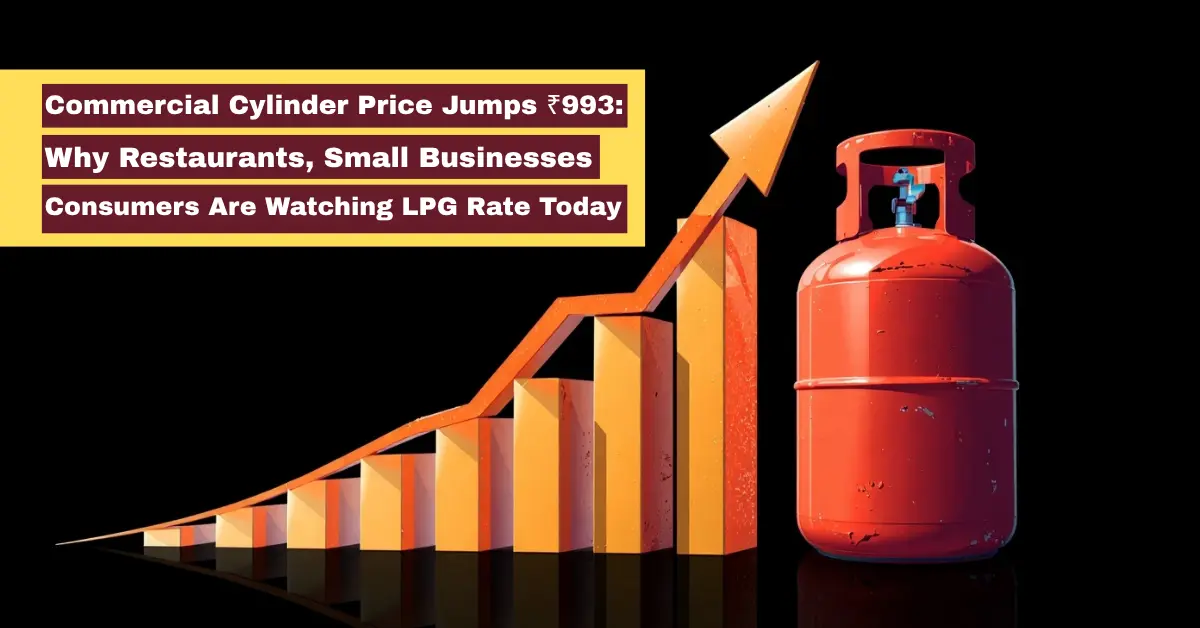
As of May 1, 2026, the price of the 19-kg commercial LPG cylinder saw an increase of ₹993. This means that the commercial LPG cylinder prices in Delhi changed from ₹2,078.50 to ₹3,071.50. This is an increase of ₹993, or 47.8%, in just one instance.
There will be direct impacts on the commercial sector in this case. LPG is an important commercial requirement for dhabas, tea stalls, sweet shops, commercial canteens, commercial kitchens, etc. Because these businesses use LPG daily, the price and usage of the LPG cylinders determines the running cost of these businesses. If the monthly burden increases by almost ₹1,000 per cylinder, the economic burden on these commercial businesses will increase sharply.
For households, the immediate impact is limited because domestic LPG has not been changed in this revision. The 14.2-kg domestic LPG cylinder price in Delhi remains ₹913, according to reported city-wise LPG updates.
Why Is LPG Price Today Trending?
Many are trying to see if the recent increases in LPG price today will impact home kitchen use as opposed to commercial use. It can be stated that almost all of the sharp increases have hit the commercial side of LPG first, while the prices for the domestic use of LPG have not changed.
Despite this, the update is still important to consumers. Commercial LPG is included in the costs of the food-service chain. If restaurants, catering services, and bakeries continue to incur higher costs of fuel, the cost of eating out, food delivery services, catering services, and prepared food will likely be affected.
This is why the news is bigger than a simple gas cylinder price update. It connects with business margins, food inflation, consumer spending and market sentiment.
How Much Has LPG Price Changed? Real Data Table
| Category | Earlier / Existing Rate | Latest Rate | Change | Real Insight |
| 19-kg commercial LPG cylinder, Delhi | ₹2,078.50 | ₹3,071.50 | +₹993 | Direct fuel-cost shock for food and hospitality businesses |
| Approximate percentage rise | — | — | 47.8% | A sharp one-time revision, not a minor monthly change |
| 14.2-kg domestic LPG cylinder, Delhi | ₹913 | ₹913 | No change | Household cooking gas users are not directly hit |
| 5-kg FTL / mini LPG cylinder | — | — | +₹261 | Smaller commercial and mini-cylinder users also face pressure |
| Petrol and diesel | Stable | Stable | No change | Retail fuel users are partly shielded in this round |
The 5-kg FTL cylinder has also been increased by ₹261, while domestic LPG rates remain unchanged.
Why Did Commercial LPG Cylinder Price Rise?
The most recent LPG hike deals with pressures from energy markets. Reuters said Indian Oil has raised industrial LPG and foreign airline jet fuel prices and has left domestic LPG and domestic jet fuel prices unchanged. This report also comes on the heels of global oil prices having surged past $100 a barrel with increased geopolitical tensions and supply threats in the Strait of Hormuz.
The pricing of fuels in India is directly determined by global prices of crude oil, LPG-related indices, imports and currency. When international energy prices rise, commercial and industrial fuel categories come under the most pricing pressure prior to household fuel categories.
Who Will Feel the Impact First?
The first impact will be felt by businesses that use LPG every day. Restaurants, hotels, dhabas, bakeries, sweet shops, tea stalls, cloud kitchens, canteens and caterers are directly exposed because cooking fuel is part of their daily cost structure.
For a small restaurant, LPG is not an occasional expense. It is part of the core operating cost. A single ₹993 hike may look like one cylinder-level change, but the real impact appears when monthly usage is calculated.
| Monthly Commercial Cylinder Use | Extra Cost Per Cylinder | Estimated Extra Monthly Burden |
| 10 cylinders | ₹993 | ₹9,930 |
| 25 cylinders | ₹993 | ₹24,825 |
| 50 cylinders | ₹993 | ₹49,650 |
| 100 cylinders | ₹993 | ₹99,300 |
This table shows why the commercial cylinder price hike matters so much for small and medium businesses. The cost does not stop at one cylinder. It multiplies with usage, and that can directly affect monthly margins.
This table shows why the commercial cylinder price hike matters so much for small and medium businesses. The cost does not stop at one cylinder. It multiplies with usage, and that can directly affect monthly margins.
How Can This Affect Restaurant Bills?
Although food businesses might not increase prices for restaurant bills as an immediate response, profit margins are under increased pressure. Increased supplier costs are absorbed by restaurants, but, in response, attempt to minimize supplier costs, improve cooking processes, and reduce food preparation and service time. As the Higher Price of LPG increases, menu prices will also increase.
There is increased pressure on small businesses and local food outlets as their profit margins are smaller and staff costs, the LPG prices, delivery platform costs, costs of cycling through available stocks, meals, and cooking costs have to be managed with delivery commission costs and branch costs.
Food products which have high levels of preparation, cooking, service or preparation and service costs will be more impacted.
Distributors and food businesses will also restructure costs, including Wholesale and Industrial Food Distribution, Catering, Catering, Catering, and Industrial Food Distribution.
Although food businesses might not increase prices for restaurant bills as an immediate response, profit margins are under increased pressure. Increased supplier costs are absorbed by restaurants, but, in response, attempt to minimize supplier costs, improve cooking processes, and reduce food preparation and service time. As the Higher Price of LPG increases, menu prices will also increase.
There is increased pressure on small businesses and local food outlets as their profit margins are smaller and staff costs, the LPG prices, delivery platform costs, costs of cycling through available stocks, meals, and cooking costs have to be managed with delivery commission costs and branch costs.
Food products which have high levels of preparation, cooking, service or preparation and service costs will be more impacted.
Distributors and food businesses will also restructure costs, including Wholesale and Industrial Food Distribution, Catering, Catering, Catering, and Industrial Food Distribution.
What Should Households Understand?
Households should understand the difference between commercial LPG and domestic LPG. The current major hike is in the 19-kg commercial cylinder, which is mainly used by businesses. The regular 14.2-kg domestic LPG cylinder used in homes has not changed in this revision.
Therefore, this increase will not affect home cooking gas customers. However, consumers will have to ensure to check city-wise LPG rates, as the prices will differ based on the region, dealer and cylinder type.
Households should understand the difference between commercial LPG and domestic LPG. The current major hike is in the 19-kg commercial cylinder, which is mainly used by businesses. The regular 14.2-kg domestic LPG cylinder used in homes has not changed in this revision.
Therefore, this increase will not affect home cooking gas customers. However, consumers will have to ensure to check city-wise LPG rates, as the prices will differ based on the region, dealer and cylinder type.
How Can This Become an Inflation Signal?
Food-service businesses incur a cost when purchasing Commercial LPG. If fuel becomes more expensive, restaurants, bakeries, hotels, canteens, and caterers may gradually pass some cost to customers. This is how a spike in commercial fuel prices can slowly affect food prices.
This does not imply that all restaurants will experience a bill increase. If LPG, diesel, and crude oil prices remain high, there is no doubt that prepared food, dining-out, and catering will all become more expensive over time.
The issue is not one LPG adjustment. Rather, the question regarding the fuel prices, is fuel high over the coming months?
Food-service businesses incur a cost when purchasing Commercial LPG. If fuel becomes more expensive, restaurants, bakeries, hotels, canteens, and caterers may gradually pass some cost to customers. This is how a spike in commercial fuel prices can slowly affect food prices.
This does not imply that all restaurants will experience a bill increase. If LPG, diesel, and crude oil prices remain high, there is no doubt that prepared food, dining-out, and catering will all become more expensive over time.
The issue is not one LPG adjustment. Rather, the question regarding the fuel prices, is fuel high over the coming months?
How Can Traders Read This Through Technical Analysis?
For both market participants and active traders, the rise in the commercial LPG price does not have to be treated only as a fuel-price headline. Considered from a broader perspective, it could turn out to be an interesting case on how macro news impacts sector mood, profit margins and price movements of stocks.
As input costs rise, there is a pressure on traders to monitor whether hotel stocks, companies in restaurant value-chain, oil marketing companies and the consumption sector as a whole show pressure or resilience in the market. Unlike reacting emotionally to the news, traders monitor the price movements, trading volumes, support and resistance levels and prevailing market sector momentum to respectively gauge whether the market is in fact pricing the cost pressure.
ICFM India helps learners understand technical analysis, chart reading and market behaviour in a structured educational way. The focus is not on tips or predictions, but on learning how to read market data, identify trends and make informed decisions with proper risk awareness.
To understand how news, price action and sector trends connect in real market conditions, learners can explore technical analysis learning resources from ICFM India for educational purposes only.
For both market participants and active traders, the rise in the commercial LPG price does not have to be treated only as a fuel-price headline. Considered from a broader perspective, it could turn out to be an interesting case on how macro news impacts sector mood, profit margins and price movements of stocks.
As input costs rise, there is a pressure on traders to monitor whether hotel stocks, companies in restaurant value-chain, oil marketing companies and the consumption sector as a whole show pressure or resilience in the market. Unlike reacting emotionally to the news, traders monitor the price movements, trading volumes, support and resistance levels and prevailing market sector momentum to respectively gauge whether the market is in fact pricing the cost pressure.
ICFM India helps learners understand technical analysis, chart reading and market behaviour in a structured educational way. The focus is not on tips or predictions, but on learning how to read market data, identify trends and make informed decisions with proper risk awareness.
To understand how news, price action and sector trends connect in real market conditions, learners can explore technical analysis learning resources from ICFM India for educational purposes only.
How Should Investors Read This News?
It shouldn't be seen as a crash signal for the stock market. Instead, consider it a margin-pressure and inflation-watch indicator. Hotel companies, restaurant companies, quick-service food companies, stocks linked to tourism, and consumption-related sectors are likely to be observed by investors.
Some businesses with pricing power may be better able to absorb the cost increase as they could pass on some of the cost to the customers. Other businesses may offer bad pricing power or weak margins, and may find it more difficult to absorb the cost if they cannot increase the selling prices without losing the demand.
From a broader perspective, the prices of crude oil, the movement of the rupee, the prices of diesel, and the changes that will be made to the pricing of LPG in the future will also be make a difference. If the cost of energy remains high, the market may become even more sensitive to inflation data and the data and comments that will be made regarding the policies."
It shouldn't be seen as a crash signal for the stock market. Instead, consider it a margin-pressure and inflation-watch indicator. Hotel companies, restaurant companies, quick-service food companies, stocks linked to tourism, and consumption-related sectors are likely to be observed by investors.
Some businesses with pricing power may be better able to absorb the cost increase as they could pass on some of the cost to the customers. Other businesses may offer bad pricing power or weak margins, and may find it more difficult to absorb the cost if they cannot increase the selling prices without losing the demand.
From a broader perspective, the prices of crude oil, the movement of the rupee, the prices of diesel, and the changes that will be made to the pricing of LPG in the future will also be make a difference. If the cost of energy remains high, the market may become even more sensitive to inflation data and the data and comments that will be made regarding the policies."
Overall View: Why This News Matters
The commercial cylinder price hike matters because it directly affects India’s food and hospitality cost chain. A 19-kg commercial LPG cylinder crossing ₹3,000 in Delhi is a strong cost signal for restaurants, hotels, caterers, cloud kitchens and small food businesses.
The consideration of domestic LPG services did not change in this revision. Therefore, the direct impact on households remains limited. In the case of businesses, the impact will be immediate. For consumers, the effect will be felt after higher fuel costs are transferred to restaurant bills, catering costs, and prepared foods.
Therefore, this is much more than a gas cylinder price update. If global oil prices remain under pressure, the cost of doing business, cost of food inflation, and changes to market sentiment will need to be studied more closely.
Disclaimer: This article is for educational and informational purposes only. LPG prices may vary by city, distributor and category. Readers should check official updates before making any business, financial or market-related decision.
The commercial cylinder price hike matters because it directly affects India’s food and hospitality cost chain. A 19-kg commercial LPG cylinder crossing ₹3,000 in Delhi is a strong cost signal for restaurants, hotels, caterers, cloud kitchens and small food businesses.
The consideration of domestic LPG services did not change in this revision. Therefore, the direct impact on households remains limited. In the case of businesses, the impact will be immediate. For consumers, the effect will be felt after higher fuel costs are transferred to restaurant bills, catering costs, and prepared foods.
Therefore, this is much more than a gas cylinder price update. If global oil prices remain under pressure, the cost of doing business, cost of food inflation, and changes to market sentiment will need to be studied more closely.
Disclaimer: This article is for educational and informational purposes only. LPG prices may vary by city, distributor and category. Readers should check official updates before making any business, financial or market-related decision.
FAQs on Commercial LPG Cylinder Price Hike and Its Impact
1. Why is commercial cylinder price trending today?
Because the price of the commercial LPG cylinder in Delhi has been raised to ₹3.071.50, the cost of the 19 kg commercial LPG cylinder has almost doubled to ₹993. Such an extreme increase can pose many issues for restaurants, hotels, caterers, cloud kitchens, and smaller client food businesses as the cost of commercial LPG is essential to their daily functioning.
Because the price of the commercial LPG cylinder in Delhi has been raised to ₹3.071.50, the cost of the 19 kg commercial LPG cylinder has almost doubled to ₹993. Such an extreme increase can pose many issues for restaurants, hotels, caterers, cloud kitchens, and smaller client food businesses as the cost of commercial LPG is essential to their daily functioning.
2. How much is the commercial LPG cylinder price in Delhi now?
As of now, the cost of a 19-kg commercial LPG cylinder in Delhi is ₹3,071.50. The price was hiked by ₹993 from a previous price of around ₹2,078.50. The price of the commercial LPG cylinder has crossed the ₹3,000 mark.
As of now, the cost of a 19-kg commercial LPG cylinder in Delhi is ₹3,071.50. The price was hiked by ₹993 from a previous price of around ₹2,078.50. The price of the commercial LPG cylinder has crossed the ₹3,000 mark.
3. Did domestic LPG cylinder prices also increase?
Actually, the most recent increase primarily impacts the commercial LPG cylinder. The 14.2-kg domestic LPG cylinder used in homes has not been modified in this update. Therefore, users of home cooking gas are not affected by the increase in commercial LPG prices.
Actually, the most recent increase primarily impacts the commercial LPG cylinder. The 14.2-kg domestic LPG cylinder used in homes has not been modified in this update. Therefore, users of home cooking gas are not affected by the increase in commercial LPG prices.
4. Why did commercial LPG cylinder prices increase?
Commercial LPG pricing is affected by increased global energy market pressures, increased movement of crude oil, import-linked fuel pricing, and supply concerns. When the international price of fuel increases, the commercial and industrial fuel category is typically subjected to quicker price revisions.
Commercial LPG pricing is affected by increased global energy market pressures, increased movement of crude oil, import-linked fuel pricing, and supply concerns. When the international price of fuel increases, the commercial and industrial fuel category is typically subjected to quicker price revisions.
5. Who will be affected by the commercial cylinder price hike?
The businesses that are likely to be most affected are those that use commercial LPG most regularly — four-star hotels, restaurants, dhabas, bakeries, sweet shops, cloud kitchens, caterers, tea shops, and canteens. An increase of ₹993 per cylinder will significantly increase their business expenses per month.
The businesses that are likely to be most affected are those that use commercial LPG most regularly — four-star hotels, restaurants, dhabas, bakeries, sweet shops, cloud kitchens, caterers, tea shops, and canteens. An increase of ₹993 per cylinder will significantly increase their business expenses per month.
6. Will restaurant food prices increase after the LPG hike?
Restaurant prices may not rise simultaneously, but rising prices in the food sector are more pronounced. Should commercial LPG remain exorbitant, restaurants and caterers may begin, in a gradual manner, to alter prices in menus, catering arrangements, or rates of prepared food.
Restaurant prices may not rise simultaneously, but rising prices in the food sector are more pronounced. Should commercial LPG remain exorbitant, restaurants and caterers may begin, in a gradual manner, to alter prices in menus, catering arrangements, or rates of prepared food.
7. How much extra cost can a restaurant face after this hike?
If a restaurant uses 10 commercial cylinders a month, the extra cost may be around ₹9,930. If it uses 25 cylinders, the monthly cost burden may rise by around ₹24,825. Larger kitchens using 50 cylinders may face nearly ₹49,650 in extra monthly cost.
If a restaurant uses 10 commercial cylinders a month, the extra cost may be around ₹9,930. If it uses 25 cylinders, the monthly cost burden may rise by around ₹24,825. Larger kitchens using 50 cylinders may face nearly ₹49,650 in extra monthly cost.
8. Is this LPG price hike bad for small businesses?
Yes, small food businesses may experience more pressure due to relatively small margins. Slashing commercial LPG costs may be the final straw for expenses such as rents, staff salaries, raw materials, electricity bills, and delivery platforms.
Yes, small food businesses may experience more pressure due to relatively small margins. Slashing commercial LPG costs may be the final straw for expenses such as rents, staff salaries, raw materials, electricity bills, and delivery platforms.
9. How can commercial LPG price affect inflation?
Commercial LPG is utilized by restaurants, bakeries, hotels, and catering companies. Businesses may transfer the cost to consumers and raise food prices if fuel prices remain high. This may indirectly signal inflation.
Commercial LPG is utilized by restaurants, bakeries, hotels, and catering companies. Businesses may transfer the cost to consumers and raise food prices if fuel prices remain high. This may indirectly signal inflation.
10. Is this LPG hike a stock market concern?
While an increase in consumer-grade LPG cylinders won’t signal an impending stock market crash, it will signal some margin pressure. The focus will most likely be on hotel stocks and restaurant chains, and quick-service food businesses, oil marketing companies, and other sectors that link to the consumer.
While an increase in consumer-grade LPG cylinders won’t signal an impending stock market crash, it will signal some margin pressure. The focus will most likely be on hotel stocks and restaurant chains, and quick-service food businesses, oil marketing companies, and other sectors that link to the consumer.
11. Which sectors may be affected by commercial LPG price hike?
The sectors to be impacted the most could be hospitality, restaurants, catering, food delivery, hotels, bakeries, cloud kitchens and tourism-linked businesses. If the cost of fuel does not improve, margins will be less optimistic for these sectors.
The sectors to be impacted the most could be hospitality, restaurants, catering, food delivery, hotels, bakeries, cloud kitchens and tourism-linked businesses. If the cost of fuel does not improve, margins will be less optimistic for these sectors.
12. Why are people confused between commercial and domestic LPG?
Many individuals want to see LPG cylinder prices without recognizing the distinctions between domestic and commercial cylinders. Commercial LPG has higher pricing due to the proprietorship prior. It is also because of the most recent commercial category pricing spike.
Many individuals want to see LPG cylinder prices without recognizing the distinctions between domestic and commercial cylinders. Commercial LPG has higher pricing due to the proprietorship prior. It is also because of the most recent commercial category pricing spike.
13. What should households do after this LPG price update?
There is no reason for households to panic as there is no change in the current revision for the domestic LPG cylinder cost. However, households are advised to check the LPG charge for their particular city as prices may vary by distributor, location and cylinder category.
There is no reason for households to panic as there is no change in the current revision for the domestic LPG cylinder cost. However, households are advised to check the LPG charge for their particular city as prices may vary by distributor, location and cylinder category.
14. What should restaurants and caterers watch next?
Restaurants and caterers should monitor LPG price revisions, the price of crude oil, diesel prices, and the price of food inputs. They should also use this data to analyze the monthly rate of usage of their cylinders, work to minimize losses, and recalculate their margins on new, large orders.
Restaurants and caterers should monitor LPG price revisions, the price of crude oil, diesel prices, and the price of food inputs. They should also use this data to analyze the monthly rate of usage of their cylinders, work to minimize losses, and recalculate their margins on new, large orders.
15. Is the commercial cylinder price hike temporary or long-term?
Several factors influence price, including global energy prices, crude oil price fluctuations, import prices, and government price control measures. If prices fall on a global scale, commercial LPG charges may drop. On the other hand, if energy pricing stays at a maximum, higher LPG payments may burden the business sector.
Several factors influence price, including global energy prices, crude oil price fluctuations, import prices, and government price control measures. If prices fall on a global scale, commercial LPG charges may drop. On the other hand, if energy pricing stays at a maximum, higher LPG payments may burden the business sector.
16. How can traders read this LPG price hike?
This can be seen as a macro-cost signal by traders. They don't just react to the news headlines, but they also look at charts to see if hotel, restaurant, oil marketing, and consumption-related stocks are getting weaker or stronger through price action, volume, and support-resistance levels.
This can be seen as a macro-cost signal by traders. They don't just react to the news headlines, but they also look at charts to see if hotel, restaurant, oil marketing, and consumption-related stocks are getting weaker or stronger through price action, volume, and support-resistance levels.