

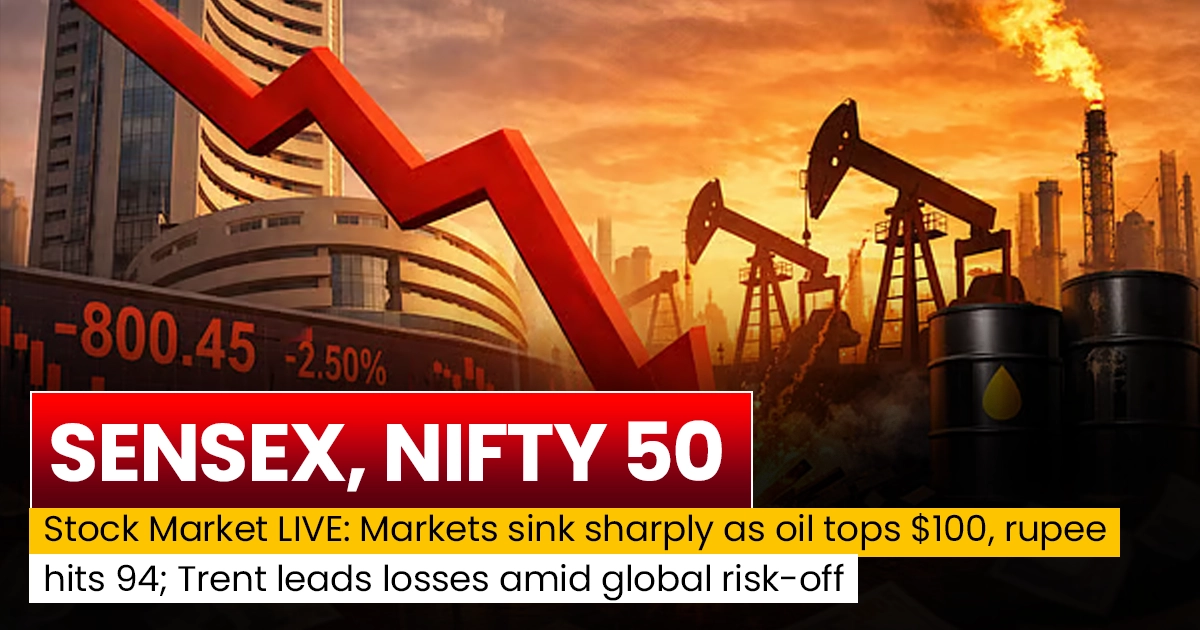
Sensex, Nifty 50 | Stock Market LIVE: Markets sink sharply as oil tops $100, rupee hits 94; Trent leads losses amid global risk-off

What Was Happening Before This Market Fall?

In the previous few trading sessions, Indian stock markets were attempting to maintain stability despite rising global uncertainty. The Sensex and Nifty were holding near higher levels, supported by selective buying and resilience in broader markets.

But pressure had already started to build beneath the surface. After tensions in the Middle East, especially around the Strait of Hormuz, which is a key global oil supply route, crude oil prices rose sharply. The Indian rupee also started to lose value, and global markets became more cautious.

Even though US markets were hitting all-time highs because companies were making a lot of money, the global macro environment was already starting to change. This means that the current drop isn't sudden; it's just a continuation of macro pressure that the markets are already taking into account. 

What Is Happening in the Stock Market Today?

Indian markets have now reacted sharply to these risks. The Sensex has fallen over 750 points, touching an intraday low of 77,693, while the Nifty 50 dropped to around 24,134, marking nearly a 1% decline.

The autumn has continued for a second session, showing that people are becoming more cautious instead of stable. The markets opened weak and kept getting weaker all day, which shows that people at higher levels don't trust them. 

Live Market Data Snapshot

IndicatorLevelInterpretation
Sensex77,693Broad-based selling
Nifty 5024,134Weak sentiment
Brent Crude$103+Inflation concern
USD/INR94.12Currency pressure

At the same time, the rupee weakened for the fourth consecutive session, slipping past the 94 mark again, which reflects growing pressure from rising import costs and global capital flows.

Why Is the Stock Market Falling Today?

The primary trigger is the surge in crude oil prices combined with escalating geopolitical tension.

Brent crude is trading above $103 per barrel, marking its fourth straight day of gains and a sharp rise of nearly 70% in 2026 so far. This surge is directly linked to disruption in the Strait of Hormuz, where tensions have intensified significantly.

Attacks on shipping routes and the seizure of ships have recently disrupted the flow of oil supplies. These things have made the global energy markets less stable, which has caused oil prices to go up.

This has a direct effect on India because the country relies on oil from other countries. Higher oil prices make imports more expensive, raise concerns about inflation, and lower expectations for how much money businesses will make.

At the same time, the falling value of the rupee makes this pressure worse by making imports more expensive. This has a macro effect that raises the risk of inflation, changes growth expectations, and lowers investor confidence. 

How Are Sectors and Stocks Reacting?

The decline is clearly visible across sectors, confirming that this is a broad-based market fall.

Sector Performance

SectorChange
Auto-1.13%
IT-1.17%
PSU Bank-1.00%
Financials-1.00%
Realty-1.05%
Metal-0.53%
Oil & Gas-0.89%
Pharma+2.38%
Healthcare+1.85%

There is a clear pattern in this data: sectors that are cyclical and sensitive to growth are losing ground, while sectors that are defensive are gaining ground. This shows that investors are becoming more interested in safety. 

Heavyweight Stocks Driving the Fall

StockChange
Trent-3%+
Reliance Industries-2%+
Tech Mahindra-2%+
Axis Bank-2%+
ICICI Bank-1.9%
HDFC Bank-1.4%

Even though some companies have made a lot of money, stocks have gone down because of how people feel about the market as a whole. For instance, Trent has gone down even though it did well, which shows that macro factors are more important than stock-specific positives.

There are also selective outperformers, though. Oracle Financial Services went up after good results in the fourth quarter. Havells, on the other hand, went down even though profits went up because of worries about margins. This shows that there is still stock-specific action in a market that is driven by the economy as a whole. 

How Are Global Markets and Assets Reacting?

The current market movement is aligned with global trends.

Global Market Snapshot

Market IndicatorChange
MSCI Asia Index-0.6%
US Futures-0.5%
Nikkei Futures-1.4%
Euro Stoxx Futures-1.1%

The bond markets are also reacting. The yield on India's benchmark bond has gone up, which means that people are more worried about inflation and the economy's stability.

Gold prices are stable even though there is a lot of uncertainty, but silver prices have been all over the place. This is part of a larger trend around the world where investors are becoming more careful. 

What Are Institutional Signals Indicating?

A major global brokerage has downgraded Indian equities to “underweight,” citing rising oil prices as a key risk.

According to estimates, a 20% rise in crude oil prices could reduce earnings growth by around 1.5 percentage points. At the same time, benchmark indices have already declined between 6% and 8% in 2026, reflecting early signs of pressure.

This indicates that institutions are beginning to factor in a more challenging macro environment.

What Could Happen Next in the Stock Market?

Markets are now adjusting expectations based on current conditions.

If crude oil prices stay high and geopolitical tensions stay high, inflation pressure could rise, earnings expectations could fall, and the market could stay very volatile. 

From a technical perspective, the market is trading below key resistance levels.

Key Levels to Watch

IndexSupportResistance
Nifty 5024,200 – 24,00024,500 – 24,700
Sensex78,200 – 77,70079,000 – 79,500

As long as markets remain below resistance, the short-term trend is likely to stay weak.

But if oil prices stay the same and tensions between countries ease, the markets may start to recover, led by big-cap stocks. 

How Should Investors Approach This Market Now?

In a macro-driven market, making decisions based on short-term price changes can be bad. The focus should change to figuring out what makes things happen, like changes in the price of crude oil, changes in currency, and events around the world.

Right now, outside factors have a bigger effect on markets than inside factors. This means that being patient and making smart choices are very important. 

What Is the Final Conclusion?

The fall in the Sensex and Nifty is not just a routine correction. It reflects a macro-driven shift caused by rising oil prices, rupee weakness, and geopolitical tension.

How these global factors change will decide which way we go next. Markets might bounce back if things get stable again. If things stay uncertain, things are likely to stay volatile. 

This is not just a market move — it is a reflection of changing global economic conditions impacting India.

Understand Market Movements, Don’t Just React

Market phases like this, when crude oil, currency changes, and world events cause prices to change, show us one important fact: price changes are not random. They have patterns, structures, and behaviors that can be studied. 

People who want to understand these kinds of market conditions should learn how to read charts, spot trends, and understand price action instead of relying on noise or short-term reactions. 

The ICFM INDIA Technical Analysis Course is meant to help students learn this in a structured way. It focuses on how markets really work, including things like finding trends, support and resistance, managing risk, and real market situations. 

This is not about predictions or quick outcomes. It is about developing clarity and a framework to interpret market movements more effectively over time.

If you're looking into how professional traders deal with such unstable situations, you can look over the program's structure and approach to see if it fits with your learning goals. 

Disclaimer

This article is for informational and educational purposes only and does not constitute financial advice.

FAQs: Sensex Crash Today, Oil Above $100 & Market Outlook (April 2026)

Why is the stock market falling today in India?

The stock market is falling today mainly due to a combination of rising crude oil prices above $100, a weakening rupee near 94 against the US dollar, and ongoing geopolitical tensions in the Middle East. These factors are increasing inflation concerns and reducing investor confidence, leading to broad-based selling in the market.

Why did Sensex fall more than 750 points today?

The Sensex dropped more than 750 points because of ongoing selling pressure caused by macroeconomic risks. Investors have cut back on their stock market exposure because of the sudden rise in crude oil prices, the problems in the Strait of Hormuz, and the weakening of the rupee. 

How does crude oil price impact the Indian stock market?

Crude oil has a direct impact on the Indian stock market because India is a major oil importer. When oil prices go up, it costs more to import goods, inflation risk goes up, and companies have less room to make money. This makes people feel bad about the market, which often causes indices like Sensex and Nifty to go down. 

Why is the rupee falling and how does it affect markets?

The rupee is going down because oil prices are going up, there is uncertainty around the world, and money is leaving the country. When the rupee is weaker, it costs more to import goods, inflation goes up, and companies' profits go down. This makes people feel bad about the stock market and puts more pressure on equity indices. 

Is today’s stock market fall a crash or a correction?

Right now, the drop looks more like a correction driven by the economy than a full market crash. But if crude oil prices stay high and geopolitical tensions stay high, the correction could get worse and make things more volatile in the next few sessions. 

Which sectors are most affected by today’s market fall?

The banking, financial services, IT, auto, and real estate sectors are the most affected because they are sensitive to changes in the economy. On the other hand, defensive sectors like healthcare and pharmaceuticals are doing better as investors move toward safer assets. 

Why are some stocks rising despite the market falling?

Some stocks go up even when the market is going down because of things that are specific to the company, like strong earnings or a good outlook. For instance, stocks that report strong quarterly results may do better than the market as a whole, even though the market is weak overall. 

What is the impact of the Strait of Hormuz situation on markets?

The Strait of Hormuz is a very important route for oil around the world. Any trouble in this area affects the supply of oil, raises prices, and makes the global economy more uncertain. This has a direct effect on markets all over the world, especially in countries that import oil, like India. 

Will the stock market recover after this fall?

A lot of the time, the recovery of the market depends on things that happen around the world. If tensions between countries ease and crude oil prices stay stable, the markets may slowly get better. But if things stay uncertain, volatility is likely to stay in the short term. 

What should investors do in a falling market like this?

Investors shouldn't let their feelings get in the way of short-term market changes. They should instead pay attention to big-picture trends, managing risk, and making decisions in a disciplined way. In these situations, it's very important to keep an eye on oil prices, currency changes, and events around the world.

Read by 0 Visitors
Lakshay Jain
About author
Lakshay Jain
From
Delhi

( Submitted News & Articles = 74 )

Search Engine Optimisation Specialist (SEO)


Download ICFM APP

Stock Market courses App