

Beginning
Most retail traders have a strange way of looking at the markets. They will spend hours looking at charts, following social media influencers, buying courses on the newest options strategy, and reading a lot of financial news, but they won't spend even a few hours testing the strategy they plan to use to see if it works. One of the biggest paradoxes of retail trading is that the most important thing to do before you start is also the thing that most people don't do.
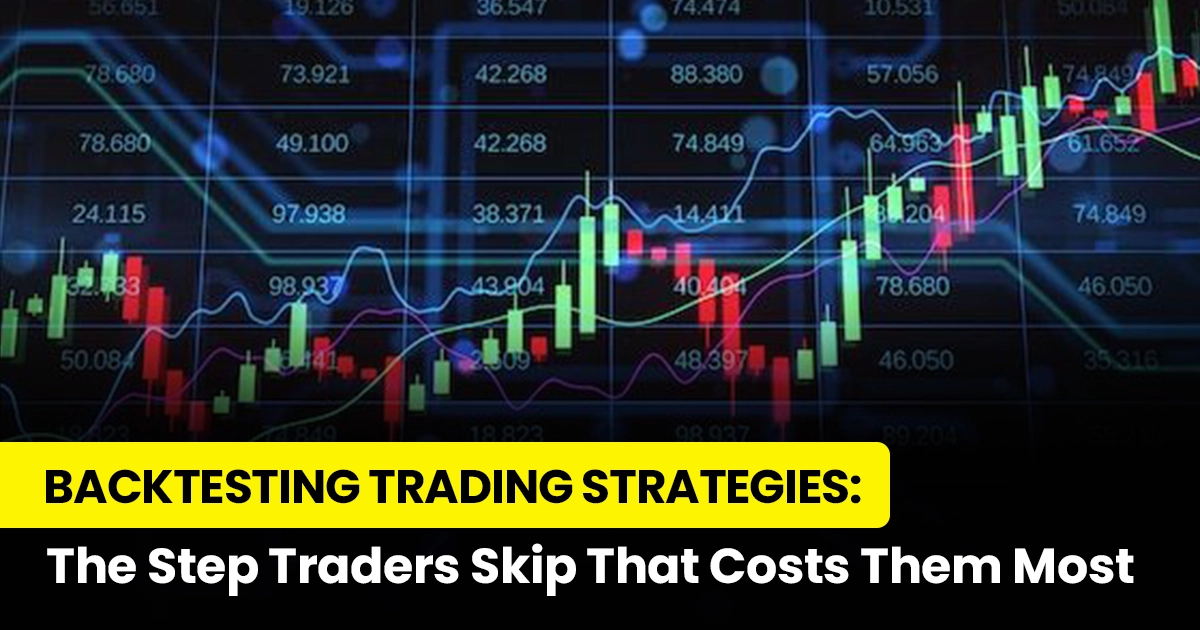
Backtesting is the step where you use historical market data to see how a trading strategy would have worked in the past. Professional traders, quantitative analysts, and hedge funds all use backtesting to make sure that every strategy works before they put any real money on the line. But most retail traders skip it completely and go straight from learning a strategy to trading it live, which usually has predictable results.
This blog talks about what backtesting is, how to do it right, why most traders don't do it, and why anyone who wants to trade profitably and for a long time must do it.
What does backtesting mean?
Backtesting is the methodical way of testing a trading strategy by running it through historical price data as if you had traded it in the past. Before you put your own money on the line, you need to know how the strategy would have worked in different market conditions, such as trending, ranging, volatile, and low-volatility.
Backtesting answers a simple question: Would I have made money if I had used these exact rules in the past? And if so, how much, how often, and what kinds of losses would I have had to deal with along the way?
You can do backtesting by hand by going through historical charts bar by bar and writing down hypothetical trades. You can also do it automatically with coding languages like Python, Pine Script (on TradingView), or dedicated backtesting platforms like Amibroker or Streak.
Why Most Traders Don't Do Backtesting
Why do most traders ignore backtesting when it is so clearly useful? The reasons are very psychological:
1. It Takes Time and Work
It's not a quick task to do backtesting correctly. It can take days or weeks to do a good backtest with a large enough sample size, like at least 100 trades, and ideally across different market regimes. Most retail traders don't have the time for this. They want to trade right now. The thrill of getting into the market is much more appealing than the steady work of analysing history.
2. Worry about what they might find
A lot of well-known trading strategies don't work, or they only work in very specific situations that might not happen again. This is an uncomfortable truth that many people don't want to hear. This inconvenient truth can be shown by backtesting. Some traders naturally stay away from backtesting because, whether they know it or not, they would rather not know than have clear evidence.
3. Too much faith in the plan
A lot of traders come across a strategy—maybe in a YouTube video, a trading group, or a book—and right away think it will work. This is the classic availability heuristic: the strategy seems logical, maybe there are a few examples that seem strong, and the trader's mind fills in the rest. Testing it would make people doubt it, and doubt is not a good feeling.
4. Not Knowing Enough About Technology
Many retail traders don't have the technical skills needed to do systematic backtesting with code. Backtesting by hand is a pain. Most traders don't bother to get around this practical barrier, even though the reward for doing so is huge.
5. Thinking that paper trading is the same as backtesting
Some traders think that forward-testing (testing a strategy live on paper without using real money) is the same as backtesting. No, it isn't. You can't really understand a strategy's characteristics with just a few weeks of paper trading because it doesn't cover different market conditions and doesn't give you enough data.
What Good Backtesting Shows
A well-done backtest gives you a lot of information that you can't get any other way:
Rate of Winning
The percentage of trades that made money. If the average win is much bigger than the average loss, a strategy with a 40% win rate can still make a lot of money. Backtesting shows this relationship exactly.
Ratio of Risk to Reward
The average profit-to-loss ratio for winning and losing trades. Even if you don't win more than half the time, a strategy with a 1:3 risk-reward ratio—losing Rs. 100 on average and winning Rs. 300 on average—can still make money.
Maximum Drop
The biggest drop in the account from the highest point to the lowest point during the backtest period. This is probably the most important psychological measure. Knowing the worst drawdown your strategy has ever had helps you size your positions correctly and get ready for the worst that the strategy is likely to do.
Expectancy
Mathematical expectancy = (Average Win x Win Rate) - (Average Loss x Loss Rate). If the expectancy is positive, the strategy will make money over time. If you know your strategy's expectancy, you can figure out how much it should make on average per trade with a fair amount of accuracy.
Consistency Across Market Conditions
A backtest should cover a range of market types, such as bull markets, bear markets, sideways ranges, and times of high volatility. A strategy that only works in one type of regime is much less useful than one that works in all types of regimes, or at least one that helps you figure out which type of regime it is best for.
Core Principle: To make sense of the results, a backtest must cover at least 100 trades over at least three to five years and cover a range of market conditions.
The Backtesting Process: A Step-by-Step Guide
Step 1: Clearly state your rules
Your strategy must be completely based on rules before you can backtest it. You can't test rules that are too vague, like "buy when the trend is up." You can test exact rules like "buy when the 20 EMA crosses above the 50 EMA on the daily chart, with RSI above 50, and exit on a close below the 20 EMA." Every rule for entering, exiting, setting a stop-loss, and sizing a position must be clear.
Step 2: Pick Your Time and Data
Choose the market (Nifty, Bank Nifty, individual stocks, etc.), the time frame (daily, hourly, 15 minutes), and the time period in the past. Make sure your data is clean and has been changed for splits and dividends. NSE gives you historical data, but premium sources like Bloomberg, Refinitiv, or tick data from exchanges give you more detailed data.
Step 3: Run the Backtest
Use the method you chose—manual chart review or coded system—to run the backtest. Keep track of every trade, including the date and price of entry, the date and price of exit, the profit or loss, and the reason for both. Backtesting by hand takes longer, but it makes you really think about the strategy. Automated backtesting is faster, but it needs to be carefully checked to make sure there are no mistakes.
Step 4: Look at the Results
Find the win rate, average win, average loss, expectancy, maximum drawdown, Sharpe ratio (if it applies), and profit factor (gross profits divided by gross losses). Find out when the strategy worked and when it didn't.
Step 5: Test for strength under stress
Adjust the parameters a little and see if the results stay the same. If a strategy only works under very specific conditions and fails when those conditions change slightly, it is probably overfitted to historical data. This is called curve-fitting. Robust strategies keep their performance at a good level even when the values of the parameters change.
The Issue of Overfitting
The backtester hates overfitting the most. It happens when a strategy is so finely tuned to past data that it just "remembers" the past instead of finding long-lasting patterns in the market. When you backtest an overfitted strategy, it will look great, but it won't work at all in real life.
To avoid overfitting, use out-of-sample testing: split your historical data into two time periods. Use the first period (in-sample data) to build and improve the strategy, and then test it on the second period (out-of-sample data) without making any changes. If the strategy does a lot worse on out-of-sample data, it is overfitted.
Backtesting tools that Indian traders can use
Streak (by Zerodha) is a no-code backtesting platform for NSE instruments.
Sensibull lets you test and analyse options-specific strategies.
TradingView Pine Script lets you write flexible scripts to test your own strategies on charts.
Amibroker is a professional-grade backtesting program that uses AFL scripting.
Python (with Backtrader, VectorBT, or Zipline) gives quantitative traders the most freedom.
Excel—good for manual backtests if you organise your data carefully
The Step That Is Missing Between Backtesting and Live Trading
A strategy is not ready for live trading just because it worked in a backtest. There is an important step between backtesting and live deployment: testing on paper (or in very small size) first. This proves that the strategy works in real life and that you can do it mechanically, without letting your feelings get in the way.
A live strategy may not do as well as its backtest because of slippage, broker fees, and the mental challenge of following rules in real time. When you backtest, make sure to include realistic transaction costs. For traders who trade often, broking and STT can eat into theoretical profits.
The Change in Mindset That Backtesting Brings
Backtesting changes the way a trader interacts with the market in a big way, even if it doesn't help them analyse it. A trader who has done a good job of backtesting a strategy knows, with statistical confidence, that they have an edge. When a trader has a string of losses, they can trust the process because they know that this is normal for the range of outcomes they studied. But a trader who doesn't have a backtested strategy can't tell the difference between normal variation and a strategy that is really broken.
This mental clarity is probably the most underrated benefit of backtesting. It changes trading from something that people do when they're upset or angry to something that people do based on facts and rules. It sets professionals apart from gamblers.
The end
Backtesting isn't very exciting. It doesn't give you the thrill of making a winning trade or the social proof of a market call that works out. It takes time and effort to do this kind of work, and you have to be honest about what the data shows, even if it goes against what you thought you would find.
But this is exactly what makes the difference between traders who make money and those who always struggle. Every big trading company, every quantitative hedge fund, and every serious systematic trader does backtesting all the time. The answer is simple: skipping backtesting is not only careless, it's also a way to hurt yourself in a game where every edge counts.
Backtesting is not optional if you really want to trade, not just out of curiosity or for fun. It is the base on which every long-lasting trading career is built. Before the market tests you, test your plan.
Backtesting Trading Strategies: The Step Traders Skip That Costs Them Most | TradeSmart

Comments
Related posts

Good data quality is essential for trading and analysis because better data supports better decisions, cleaner charts, and more reliable ....
Backtesting helps traders test strategies on historical data, judge performance, and build more confidence before risking real money.

Understand slippage and liquidity in trading, why they affect order execution, and how traders can reduce unnecessary trading costs.
A structured daily trading routine helps traders stay disciplined, reduce stress, and follow a more consistent process every day.
Trade reviews help traders study what worked, what failed, and how to improve performance through honest self-evaluation.