
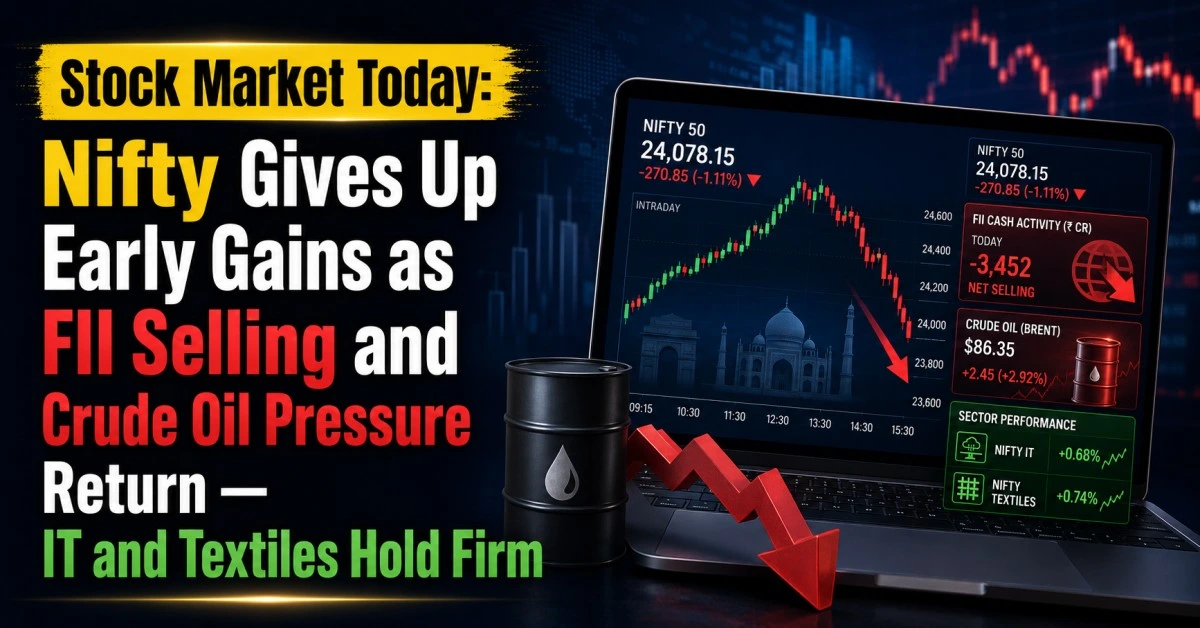
Stock Market Today: Nifty Gives Up Early Gains as FII Selling and Crude Oil Pressure Return β€” IT and Textiles Hold Firm

Apply Now

The Indian stock market opened on a positive note this morning but could not hold onto those gains. By mid-session, both Nifty 50 and BSE Sensex had slipped back into cautious territory. The reason is not a mystery β€” heavy foreign institutional investor (FII) selling, rising crude oil prices, and a critical RBI policy decision just days away are keeping traders on edge.

This is not a market to trade carelessly. But it is also not a market to fear blindly. Let us break down exactly what is happening and what it means for you.

What Happened in the Market Today?

Nifty 50 traded around the 23,500 zone during mid-session, while BSE Sensex hovered near 74,780 after both indices had opened with gains of roughly 0.7%. That early optimism faded quickly as selling pressure returned.

The broad market tone is cautious, but not uniformly weak. Two sectors β€” IT and textiles β€” are clearly outperforming today, while index-heavy stocks are feeling the drag from institutional selling.

This is what traders call a selective market. Money is not leaving the market entirely. It is moving away from uncertainty and into sectors with a clear, near-term reason to perform.

Why Did the Early Rally Fail?

Three factors knocked out the morning momentum:

1. Heavy FII selling Foreign institutional investors sold approximately $2.22 billion worth of Indian equities in the previous session, largely linked to MSCI index rebalancing. When that kind of institutional money exits, it hits large-cap index stocks the hardest. Today's weak index performance is a direct consequence of that hangover.

2. Crude oil climbing again Brent crude rose roughly 2.4% to around $93 per barrel. For India β€” which imports over 85% of its crude oil requirement β€” this matters beyond just a headline number. Higher crude pushes up inflation, pressures the rupee, and increases input costs across multiple sectors including paint, plastics, logistics, and aviation. It also changes how the RBI may choose to communicate its policy stance.

3. RBI policy decision on June 5 The Reserve Bank of India's Monetary Policy Committee meets this week, with the decision expected on June 5. Markets currently expect the repo rate to remain unchanged at 5.25%. But the rate number is only half the story. What the RBI says about inflation, liquidity, and economic growth will shape sentiment for rate-sensitive sectors β€” banking, NBFCs, auto, and real estate β€” for weeks to come. Traders are not willing to take large directional bets ahead of that.

Today's Key Market Numbers at a Glance

IndicatorLevel / Data PointWhat It Signals
Nifty 50~23,500 zone (mid-session)Caution after failed early rally
BSE Sensex~74,780 (mid-session)Flat-to-weak; below morning highs
FII Net Outflow (prev. session)~$2.22 billionMSCI-driven selling; weighs on large-caps
Nifty ITUp ~3.2%Strongest sectoral performer today
Brent Crude~$93/barrel (+2.4%)Inflation and rupee pressure risk
Cotton Import Duty11% suspended till Oct 30Key trigger for textile sector gains
Repo Rate (expected)5.25% (no change)RBI decision on June 5 is the live event

Note: All figures are indicative mid-session levels as of approximately 11:30 AM IST. Markets are dynamic β€” always check live data before making any trading decision. Click Now

Why Are IT Stocks the Top Performer Today?

Nifty IT is up around 3.2% β€” the clearest bright spot in an otherwise cautious market.

Indian IT companies β€” TCS, Infosys, Wipro, HCL Technologies, Tech Mahindra β€” tend to move in response to global technology sentiment, US market cues, dollar-rupee movement, and expectations around client IT budgets. When global tech sentiment is positive and the dollar is relatively firm against the rupee, Indian IT companies benefit both from higher export revenues and improved investor appetite.

Today, a combination of positive global tech cues and a supportive currency environment is driving that 3.2% move.

One strong session does not make a trend. But for traders already positioned in quality IT names, today's momentum is meaningful. Longer-term investors should still evaluate IT stocks based on earnings growth visibility, deal wins pipeline, operating margins, and management guidance β€” not just a single day's move.

Why Are Textile Stocks Gaining Attention?

The government has suspended the 11% customs duty on cotton imports until October 30, 2026. This is a direct and meaningful input cost relief for textile manufacturers.

Cotton is the primary raw material for most Indian textile companies. When import duty on cotton is reduced or suspended, manufacturers can source raw material at lower cost β€” improving margins, supporting production volumes, and making Indian textile exports more competitive in global markets.

As a result, several textile stocks saw fresh buying interest today. This is a classic news-driven sector move β€” a clear policy trigger with a direct financial impact on specific companies.

That said, textile companies also operate in a complex environment shaped by global order flow, energy costs, labour dynamics, and the health of key export markets like the US and EU. The cotton duty relief is a positive, but it is one variable among many.

The Real Picture Behind Today's Market

Here is the honest read of today's session:

The market is not in freefall. But it is not in a buying frenzy either. It is pausing β€” carefully β€” ahead of a major policy event, while absorbing the impact of large institutional selling.

In this kind of market, the money tends to concentrate in two places: sectors with fresh fundamental triggers (like textiles today) and sectors with global tailwinds (like IT today). Everything else trades sideways or weakly until there is a reason to move.

This sector rotation pattern is one of the most important things active traders and market students should understand. The index number alone tells you very little. The money flow within the market tells you a great deal more.

What Should Traders Watch Closely Right Now?

The Nifty 23,500 zone is the key level to watch. If the market holds above this area into the close with reasonable volumes, it signals that buyers are still engaged. If this level breaks on strong selling, short-term volatility is likely to increase.

FII and DII daily data β€” available after market hours β€” will confirm whether institutional selling continued or if domestic institutions (mutual funds, insurance companies) stepped in to absorb that supply. DII buying has often cushioned FII selling in recent months.

Crude oil direction β€” any further rise toward $95 or above will add to market anxiety about inflation and the rupee. A pullback would be a mild positive for sentiment.

RBI tone on June 5 β€” beyond the rate decision itself, watch for language around inflation trajectory, liquidity conditions, and the rupee. A neutral-to-dovish tone will comfort rate-sensitive sectors. A hawkish undertone will create fresh selling in banking and NBFC stocks.

Who Should Be Extra Careful Right Now?

New traders and beginners: Volatile, event-heavy markets are not forgiving of impulsive decisions. If you do not have a clear entry rationale, a pre-defined stop-loss, and a realistic target β€” do not trade.

High-leverage intraday traders: Event uncertainty can trigger sharp, fast moves in both directions. Leverage amplifies both gains and losses. Reduce position size around major events like the RBI decision.

Options traders: Implied volatility typically rises ahead of major policy announcements. Option premiums can be inflated before the event and collapse sharply after it β€” even if the market moves in your direction. Understand how volatility affects your positions, not just the price.

Long-term equity investors: One volatile session does not define a company's fundamental value. Avoid panic-selling quality stocks because the index is weak for a day. But do use periods of volatility to review holdings with weak earnings, high debt, or deteriorating fundamentals.

How to Actually Learn from Days Like Today

Most market news is consumed passively β€” people read the headline and move on. The traders and investors who build real skill do something different: they connect the news to the price action, to the sector movement, and to the underlying economic logic.

Today's session is a live classroom. FII selling, crude oil, RBI policy uncertainty, IT sector momentum, and a cotton duty trigger β€” all of these events have direct, traceable effects on specific stocks and sectors. Understanding why the market moved the way it did today is far more valuable than just knowing that it moved.

This is precisely the kind of practical, news-to-market-impact analysis that ICFM's courses are built around. At ICFM in Laxmi Nagar, the focus is on teaching students to read equity markets, understand technical setups, interpret derivatives data, and manage risk in real market conditions β€” not in theory, but through live-market learning.

If you find yourself reading market news but struggling to translate it into actual trading confidence, a structured course may be the fastest way to bridge that gap.

Explore ICFM's stock market courses β†’ Click Now

Final Market View

The Indian stock market today is cautious but selective. Nifty and Sensex gave up early gains under the weight of FII selling and crude oil pressure. The RBI policy decision on June 5 is keeping most traders in wait-and-watch mode.

Within this cautious setup, IT stocks are the clear outperformer on global tech cues, and textile stocks are seeing buying interest on the cotton duty relief. These two sectors are worth watching closely.

For traders: fewer setups, tighter risk management, and patience before the RBI event. For investors: ignore the noise, focus on fundamentals, and avoid emotional selling.

Preparation beats prediction in markets like this one.


This article is for educational and informational purposes only. It does not constitute investment advice, a buy/sell recommendation, or a solicitation of any kind. Stock market trading and investing involve substantial risk, including the possible loss of principal. All data points mentioned are indicative mid-session figures and may not reflect final closing levels. Readers are advised to conduct their own due diligence or consult a SEBI-registered investment advisor before making any financial decisions. ICFM does not guarantee returns, job placement, or trading success.


Frequently Asked Questions on Stock Market Today

Q: Why did Nifty and Sensex fall today after opening higher?

Nifty and Sensex opened roughly 0.7% higher but lost those gains by mid-session. Three factors hit simultaneously β€” FII selling worth approximately $2.22 billion linked to MSCI index rebalancing, Brent crude rising close to $93 per barrel, and trader caution ahead of the RBI policy decision on June 5. When all three pressures arrive together, early rallies rarely hold.

Q: What is FII selling and how does it affect the Indian stock market?

FII stands for Foreign Institutional Investor β€” large global funds that invest in Indian equities. When FIIs sell heavily, it increases share supply and reduces confidence in index-heavy stocks like Reliance, HDFC Bank, and Infosys. Because these stocks carry heavy weightage in Nifty and Sensex, large FII exits pull the entire index lower even if other stocks remain stable.

Q: What is MSCI index rebalancing and why does it cause FII outflows in India?

MSCI periodically reviews the weightage of countries and stocks in its global indices. Large foreign funds that track MSCI must buy or sell Indian stocks mechanically whenever India's weightage changes β€” not because of any negative view on India, but to stay aligned with the index. Today's $2.22 billion FII outflow was one such technical, rebalancing-driven sale rather than a fundamental exit from Indian markets.

Q: How does rising crude oil price affect the Indian stock market?

India imports over 85% of its crude requirement. When Brent crude rises β€” as it did today toward $93 per barrel β€” it raises the country's import bill, pressures the rupee, and increases inflation risk. This directly hits aviation, logistics, paint, and plastics sectors. It also makes the RBI's communication on June 5 more cautious, which weighs on rate-sensitive sectors like banking, NBFCs, and auto.

Q: What should traders expect from the RBI policy decision on June 5, 2026?

Most economists expect the repo rate to remain unchanged at 5.25%. But the rate number is only part of the picture. Traders will closely watch the RBI's tone on inflation, liquidity, growth, and the rupee. A dovish or neutral tone will support banking, NBFC, auto, and real estate stocks. A hawkish tone β€” even without a rate hike β€” can trigger fresh selling across all rate-sensitive sectors.

Q: Why is Nifty IT rising when the broader market is weak today?

Indian IT companies like TCS, Infosys, Wipro, HCL Technologies, and Tech Mahindra earn the bulk of their revenues in US dollars. When global technology sentiment is positive and the dollar holds firm against the rupee, these companies benefit on two fronts β€” higher export revenues and stronger investor appetite. Today, positive global tech cues pushed Nifty IT up roughly 3.2%, making it the standout performer in an otherwise cautious market.

Q: Why are textile stocks gaining today and which companies benefit from the cotton duty relief?

The government has also suspended an 11 per cent customs duty on import of cotton till October 30, 2026. Cotton is the main raw material for the textile manufactures of India. Lower import duty leads to lower input costs, better margins and improved price competitiveness in global export markets. Textile companies that export clothes, make cloth and spin thread are the immediate beneficiaries of this policy trigger. 

Q: What is sector rotation and why does it matter for traders today?

Sector rotation is when institutional and retail money shifts from one sector to another based on new triggers. Today is a textbook example β€” FII selling has hurt large-cap index stocks, while fresh policy news has pushed money into IT and textiles. Traders who only watch the Nifty level miss this entirely. Tracking where money is actually moving within the market is often more useful than watching the headline index number.

Q: What is the key support level for Nifty 50 to watch today?

The 23,500 zone is the critical level to monitor. If Nifty holds above this area into the close β€” especially on decent volumes β€” it signals buyers are still engaged and the market is consolidating rather than breaking down. If this level fails on heavy selling, expect short-term volatility to increase sharply. Traders should reduce position size and wait for confirmed stabilisation before entering fresh trades.

Q: How do I learn to understand market news and use it for actual trading?

Reading market news is easy. Knowing what to do with it is the real skill. It requires understanding how each economic event β€” FII flows, crude oil moves, RBI policy, sector-specific triggers β€” translates into price movement on specific stocks and indices. This is exactly the practical, news-to-market analysis approach taught at ICFM in Laxmi Nagar, Delhi β€” through live sessions covering equity markets, technical analysis, derivatives, and risk management. Visit icfmindia.com to explore courses.

Read by 0 Visitors
Lakshay Jain
About author
Lakshay Jain
From
Delhi

( Submitted News & Articles = 96 )

Search Engine Optimisation Specialist (SEO)


Download ICFM APP

Stock Market courses App