
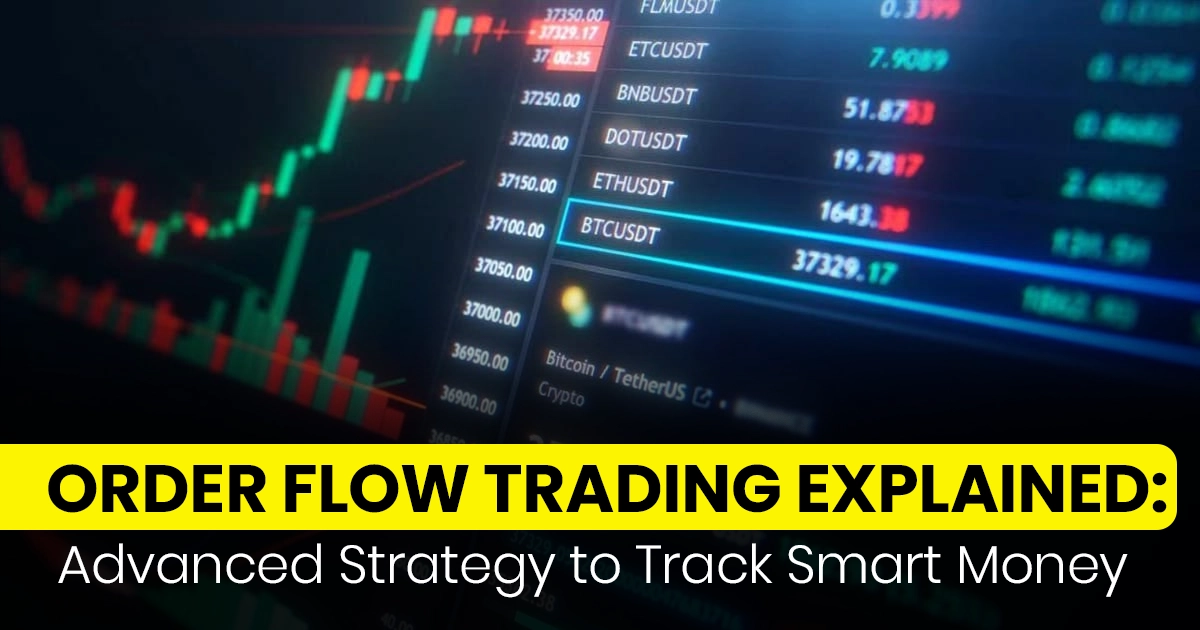
Order Flow Trading: The Complete Guide to Knowing How the Market Moves Like a Pro
In today's fast-paced financial markets, traditional indicators often don't keep up with price. Order Flow Trading is a powerful idea that professional traders use to really understand what's going on in real time.
Order Flow shows you more than just price changes; it shows you real buying and selling in the market. It helps you figure out who's in charge, where institutions are working, and where the market is likely to go next.
To trade like smart money and get a bigger edge, you need to know how to read Order Flow.
What is trading based on order flow?
Order Flow Trading looks at real-time market transactions and focuses on:
Orders to buy (demand)
Orders to sell (supply)
How people act in the market
Order Flow is different from traditional indicators because it shows what's going on right now instead of looking at past data.
👉 To put it simply:
Order Flow = A fight between buyers and sellers in real time
Important Ideas in Order Flow
You need to know these basic parts to understand Order Flow:
1. Bid and Ask Bid Price → The highest price a buyer is willing to pay
Ask Price: The lowest price a seller is willing to take
The spread is the difference between them.
2. Market Orders vs. Limit Orders
Market Orders → Done right away at the current price
Limit Orders: Set at certain price levels
👉 Limit orders give liquidity, while market orders change the price.
3. Delta of Volume
Volume Delta shows how much different there is between:
Volume of purchases (at ask)
Selling volume (at ask)
Positive Delta means that buyers are aggressive.
Negative Delta means that sellers are aggressive.
4. Cash flow
The number of open orders in the market is what liquidity means.
Strong support/resistance when liquidity is high
Low liquidity means prices move quickly.
5. Market Depth (DOM)
DOM, or Depth of Market, shows
Pending orders to buy
Pending orders to sell
👉 It helps traders find out where big orders (institutional activity) are.
Why Order Flow Matters
Professional traders use Order Flow a lot because:
1. Insight in Real Time
You can see real transactions, not indicators that are behind.
2. Find out what smart money is doing
Find out where institutions are buying or selling.
3. Makes the timing of trade better
Helps you get in at the right times.
4. Confirms breakouts
Look at real volume to avoid false breakouts.
Tools for Trading in Order Flow
1. Charts of footprints
Footprint charts show:
The amount of trade at each price
Buy and sell imbalance
👉 They show in detail what is going on in the market inside each candle.
2. DOM (Depth of Market)
Shows the order book in real time:
Bids to buy
Asks (sell orders)
👉 Good for short-term trades and scalping.
3. Volume Profile
Shows where most of the trading has taken place.
👉 Helps find important levels like:
POC (Point of Control)
Value Area
How to Use Order Flow to Trade
Let's talk about useful strategies:
1. Setup for the Order Flow Breakout Strategy:
Price gets close to resistance
A lot of people want to buy (high volume at ask)
Confirmed breakout
👉 Enter when aggressive buyers are in charge.
2. Strategy for Absorption
When absorption happens,
Big limit orders take in market orders.
Price doesn't move easily even though there are a lot of them.
For example:
Sellers keep placing market orders.
Price doesn't go down, so buyers take it in.
👉 This often leads to a change.
3. Trading with an imbalance
When there is an imbalance,
One side (buyers or sellers) is in charge.
Signal to Buy:
Strong imbalance in buying
Price goes up
Signal to Sell:
Strong imbalance in selling
Prices go down
4. The Liquidity Grab Strategy
Market a lot:
Moves to places with a lot of cash flow
Stops losses
👉 Price goes back up after a liquidity grab.
Order Flow vs. Regular Indicators
Order Flow Indicators
Type of data: Real-time or historical Accuracy: High or moderate Lag: No or yes
High complexity, low complexity Order Flow gives you more information than lagging indicators do.
Benefits of Trading with Order Flow
Understanding the market in real time
Finds out what institutions are doing
Makes entry and exit more accurate
Decreases false signals
Works best for short-term trading and scalping
Order Flow's Limitations
Needs advanced software and tools
More difficult to learn
Can be too much for beginners
Needs to make decisions quickly
Order Flow: Tips from the Pros
Start with the Basics
First, learn about the bid-ask and volume
Add to Price Action
Don't just look at the data
Concentrate on Key Levels
Use support and resistance with order flow.
Practice in Real Markets
Experience is important
Example from the Real Market (Conceptual)
If a stock is worth ₹100,
Big buy orders come in at ₹99.80.
Sellers try to lower the price.
Price stays the same
👉 Buyers are taking on selling pressure
Then:
There seems to be a lot of buying going on.
The price goes up to ₹102.
👉 This proves that the market is bullish.
Who Should Use Order Flow?
Order Flow is great for:
Traders during the day
Scalpers
Traders who work for a living
Traders of options
Traders who use algorithms
In the end
One of the most advanced and powerful ways to understand the market is through order flow trading. It changes your view from just looking at prices to looking at what is actually happening in the market.
Traders can make better choices and avoid common mistakes by looking at buying pressure, selling pressure, liquidity, and volume.
It does, though, need practice, discipline, and the right tools. Begin with the basics, add to your knowledge bit by bit, and gradually include Order Flow in your trading plan.
Last thought:
"Order Flow shows the reason, but Price shows the result."
Once you learn how to use Order Flow, you'll be able to see the market like a pro.